
How to Make Smooth Custard Without Curdling: The Science of Tempering and 78°C
Custard thickens when egg proteins form a delicate network. Learn why custard curdles, how tempering works and why about 78°C is the key stopping point.
A good custard looks effortless. It pours in a silky ribbon, coats the back of a spoon and feels rich without feeling heavy. A bad custard can change in seconds: smooth one moment, grainy and curdled the next.
The difference is a narrow but understandable piece of protein chemistry.
Custard is essentially a sweetened dairy liquid thickened by egg proteins. Your job is to encourage those proteins to form a loose, delicate network throughout the liquid without letting them clump into obvious pieces of cooked egg.
The short answer
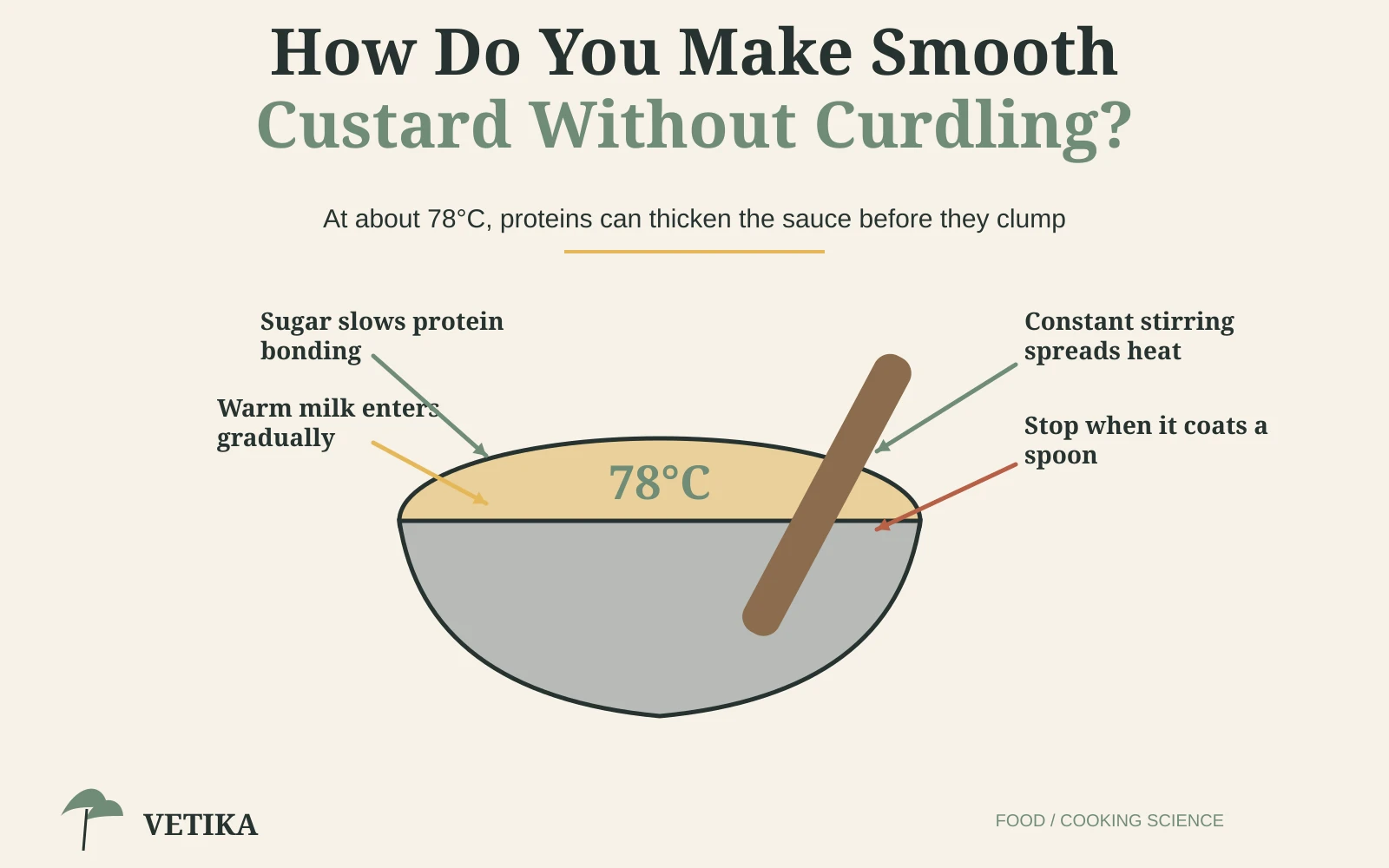
Custard thickens because egg proteins unfold and link together as they heat. If heating is gradual and the mixture is stirred, the proteins can form a fine network that thickens the milk or cream smoothly.
If the mixture gets too hot or heats unevenly, the proteins bond too aggressively, forming clumps. That is the moment a custard “curdles.”
The book’s crème anglaise method aims for about 78°C / 172°F, where the mixture coats a spoon, then comes off the heat immediately.
Why custard does not behave like scrambled eggs
Both custard and scrambled eggs rely on the same basic event: egg proteins unfold and connect.
But custard contains far more liquid, plus sugar and dairy components that get in the proteins’ way. This slows their ability to find and bond with one another. The source explains that these extra molecules raise the effective temperature at which the proteins come together.
That interference is useful. It creates a wider window in which the custard can thicken smoothly instead of turning into sweet scrambled eggs.
What sugar is doing
Sugar is not only there for sweetness. In the source method, yolks are whisked with sugar before warm milk is added. The sugar helps make it harder for the egg proteins to connect too quickly.
This gives you more control as the mixture heats.
That is a recurring theme in cooking science: ingredients often have a structural job in addition to their obvious flavour job.
Why tempering matters
“Tempering” sounds technical, but the idea is simple: warm the egg mixture gradually instead of shocking cold yolks with a large amount of very hot liquid.
The book’s method pours warm milk into the yolk-and-sugar mixture in a thin stream while whisking constantly. This lets the temperature rise progressively and reduces the chance that local hot spots will cook the proteins into clumps.
The goal is not to make the egg mixture hot as quickly as possible. The goal is to make it hot evenly.
Custard in 4 controlled steps
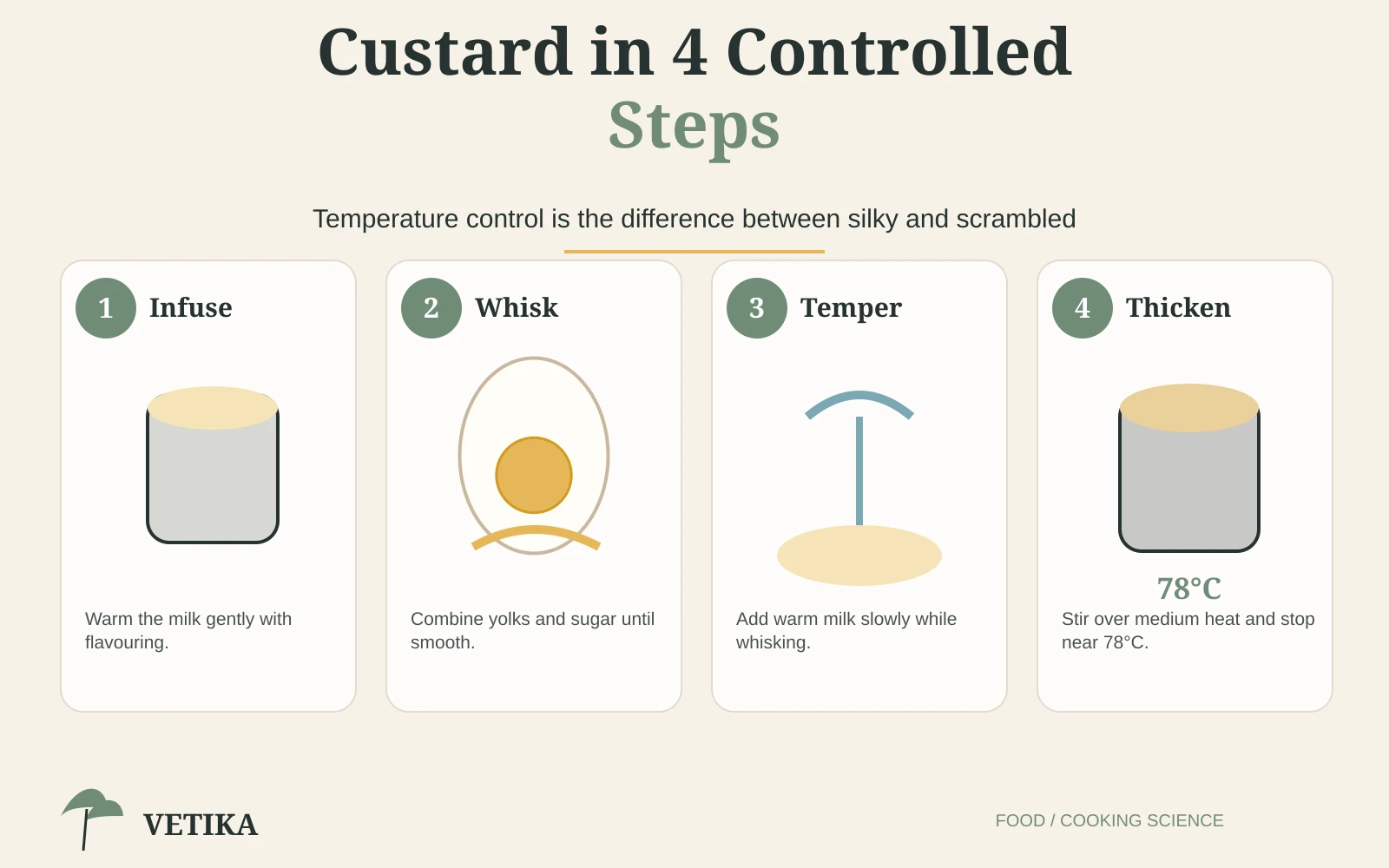
1. Infuse the milk
Warm the milk gently with flavouring such as vanilla. Heat helps move aromatic compounds into the dairy. The source brings the milk close to a simmer, then rests it to continue the infusion.
2. Whisk yolks and sugar
Combine the yolks with sugar until smooth and lighter in appearance. The yolks provide the proteins that will thicken the custard; the sugar slows their tendency to clump.
3. Temper with warm milk
Pour the warm milk in gradually while whisking. This raises the yolk temperature gently.
4. Heat and stir until the spoon coats
Return the mixture to the pan and stir constantly. The source identifies roughly 78°C as the point where the network has developed enough to coat the back of a spoon. Remove it from the heat at that point.
Why constant stirring helps
Stirring does several things at once:
- it evens out the temperature;
- it prevents the base of the pan becoming much hotter than the rest;
- it disrupts local clusters before they become large curds;
- it gives you a better sense of when the texture starts changing.
In other words, stirring is both heat management and structure management.
What “coats the back of a spoon” really means
The phrase sounds old-fashioned, but it is useful. A properly thickened pouring custard is viscous enough to leave an even film on the spoon instead of running off like plain milk.
That visual change tells you a protein network has formed throughout the liquid.
You are not waiting for the custard to become pudding-thick in the pan. If you do, you are already much closer to overcooking it.
Why custard curdles
Curdling is simply the same protein reaction pushed too far.
Too much heat, too little stirring or a hot spot on the pan can make the proteins clump tightly. Once those clumps become visible, the texture changes from silk to grain.
This is why gentle heat and timing matter more than brute force.
Does cream make custard easier?
The source notes that a thicker custard can be made with a higher proportion of cream or additional yolks. More dairy fat changes richness and texture, while more yolk increases thickening power.
But more yolk also brings more egg flavour and more protein, so “more” is not automatically better.
The useful lesson is to decide what kind of custard you want: a pourable crème anglaise or a richer, thicker base.
What if the custard starts thickening too quickly?
The book’s key instruction is to remove the pan as soon as the correct coating texture appears. The safest response to a rapidly thickening custard is therefore not to keep pushing. Take away the heat.
This pack deliberately does not invent a rescue technique the source does not provide. The article stays focused on prevention: gradual tempering, constant stirring and stopping at the right moment.
The deeper lesson
Custard is a controlled version of the same protein chemistry you see in scrambled eggs. The difference is that the proteins are diluted, sweetened and surrounded by dairy, which changes how quickly they can connect.
That makes custard one of the best examples of how cooks manipulate molecular crowding and temperature to create texture.
You are not merely “heating milk and eggs.” You are building a protein mesh delicate enough to thicken a liquid without revealing itself as chunks.
FAQs
Why does custard curdle?
Because the egg proteins have bonded too tightly, usually after overheating or uneven heating, and form visible clumps instead of a fine network.
What temperature should pouring custard reach?
The book’s method targets about 78°C / 172°F for a custard that coats the back of a spoon.
Why temper eggs with warm milk?
Tempering raises the egg temperature gradually and reduces the chance of sudden local coagulation.
Why does sugar help custard stay smooth?
The source explains that sugar interferes with protein bonding, making clumping more difficult and giving the cook more control.
Why do you need to stir constantly?
Stirring distributes heat and helps prevent local protein clusters from turning into curds.