
Why Does Yogurt Curdle in Hot Dishes? The Science of Acid, Heat and Smooth Sauces
Yogurt curdles when acid and heat push milk proteins into clumps. Learn why it happens, why full-fat yogurt is more stable and how to keep sauces smooth.
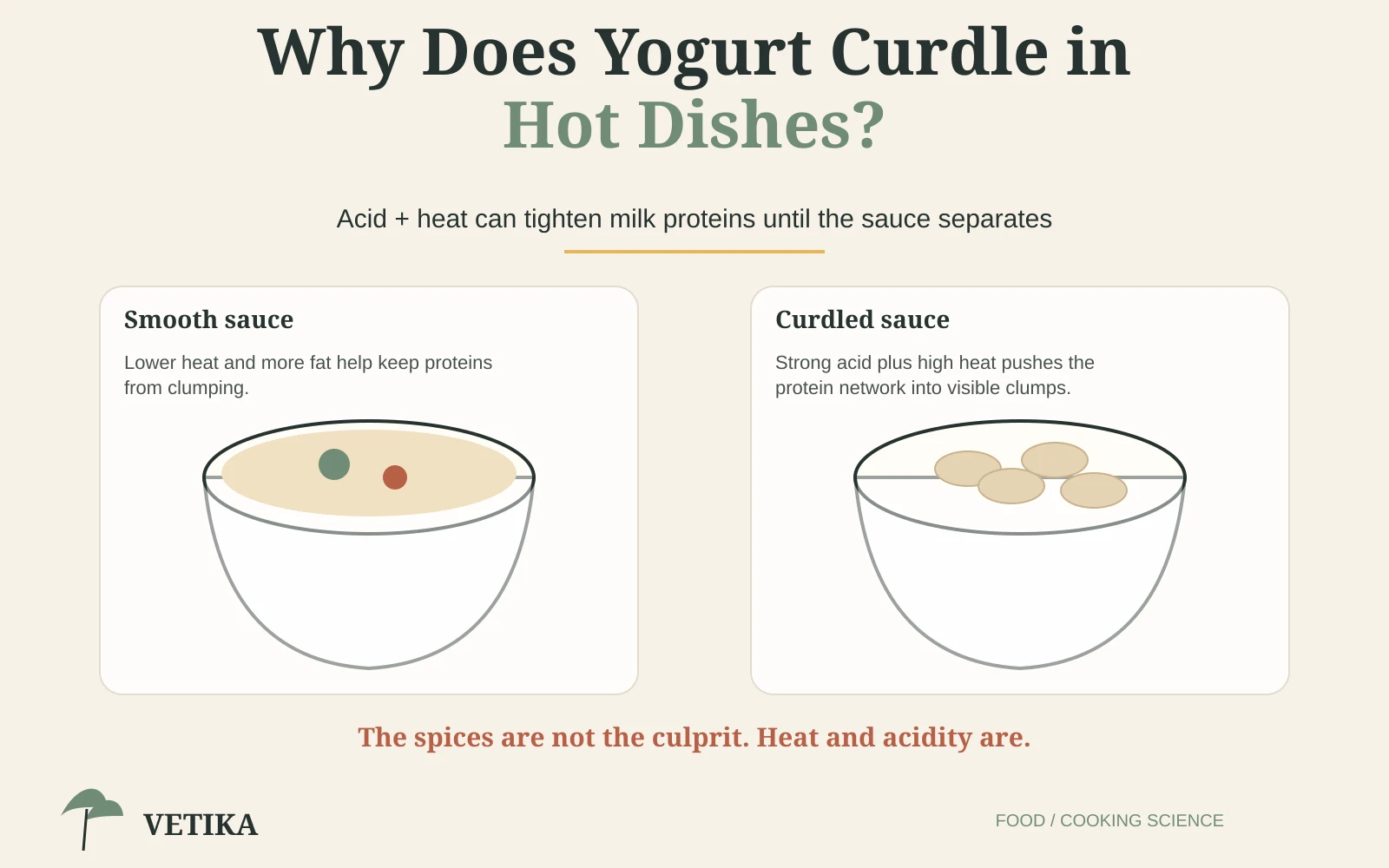
Yogurt is one of those ingredients that can make a sauce instantly feel brighter, richer and fresher—right up until it turns grainy and separates into curds and watery whey.
When that happens in a curry, soup or stew, people often blame the spices. The book makes the mechanism much clearer: the real problem is usually heat plus acidity.
Yogurt already contains a delicate network of milk proteins. Strong acid and high heat push that network harder. Eventually it tightens into visible clumps and expels liquid.
The short answer
Yogurt curdles in hot dishes because acid and heat destabilise its casein-protein network. High temperature makes the proteins contract and clump more aggressively, while acidic ingredients such as tomato, lemon juice, vinegar or fruit make the network more vulnerable.
The spices themselves are not the main cause.
The source recommends adding yogurt toward the end of cooking, when the dish has cooled somewhat, rather than boiling it. It also notes that higher-fat yogurt is less likely to split because fat globules help keep the proteins apart.
What yogurt actually is
Yogurt is milk transformed by bacterial fermentation. The bacteria produce lactic acid, and that acid changes the behaviour of casein proteins in the milk. Instead of remaining freely dispersed, the proteins form a soft gel network that gives yogurt its characteristic body.
That means yogurt is already a carefully balanced structure before it enters your sauce.
When you heat it with additional acid, you are asking that structure to survive a second stress.
Why acid makes the problem worse
Tomatoes, citrus juice, vinegar and some fruits all push the environment further toward acidity. The yogurt is already acidic, so these ingredients bring the proteins closer to conditions in which they prefer to clump tightly.
Add strong heat at the same time and the effect accelerates.
This is why a tomato-rich curry is a classic place for yogurt to split even though the spice mix itself is innocent.
Why heat speeds up curdling
Heat gives proteins more energy and changes how they move and connect. At gentle temperatures, the yogurt network may remain reasonably intact. As the temperature rises, proteins can draw together more strongly and squeeze out water.
Visually, the sauce changes from smooth and glossy to grainy, with pale curds floating in thinner liquid.
The process is related to other protein transformations in this cluster—scrambled eggs, custard and milk skin—but the exact proteins and conditions differ.
Why full-fat yogurt is more forgiving
The book notes that full-fat yogurt is less likely to curdle because the fat globules get between casein proteins and make it harder for them to form large clumps.
This is an important structural role for fat. It is not just there for flavour and richness; it can change how easily proteins interact.
That is why low-fat dairy sauces can be more fragile under heat.
How to keep yogurt sauces smooth
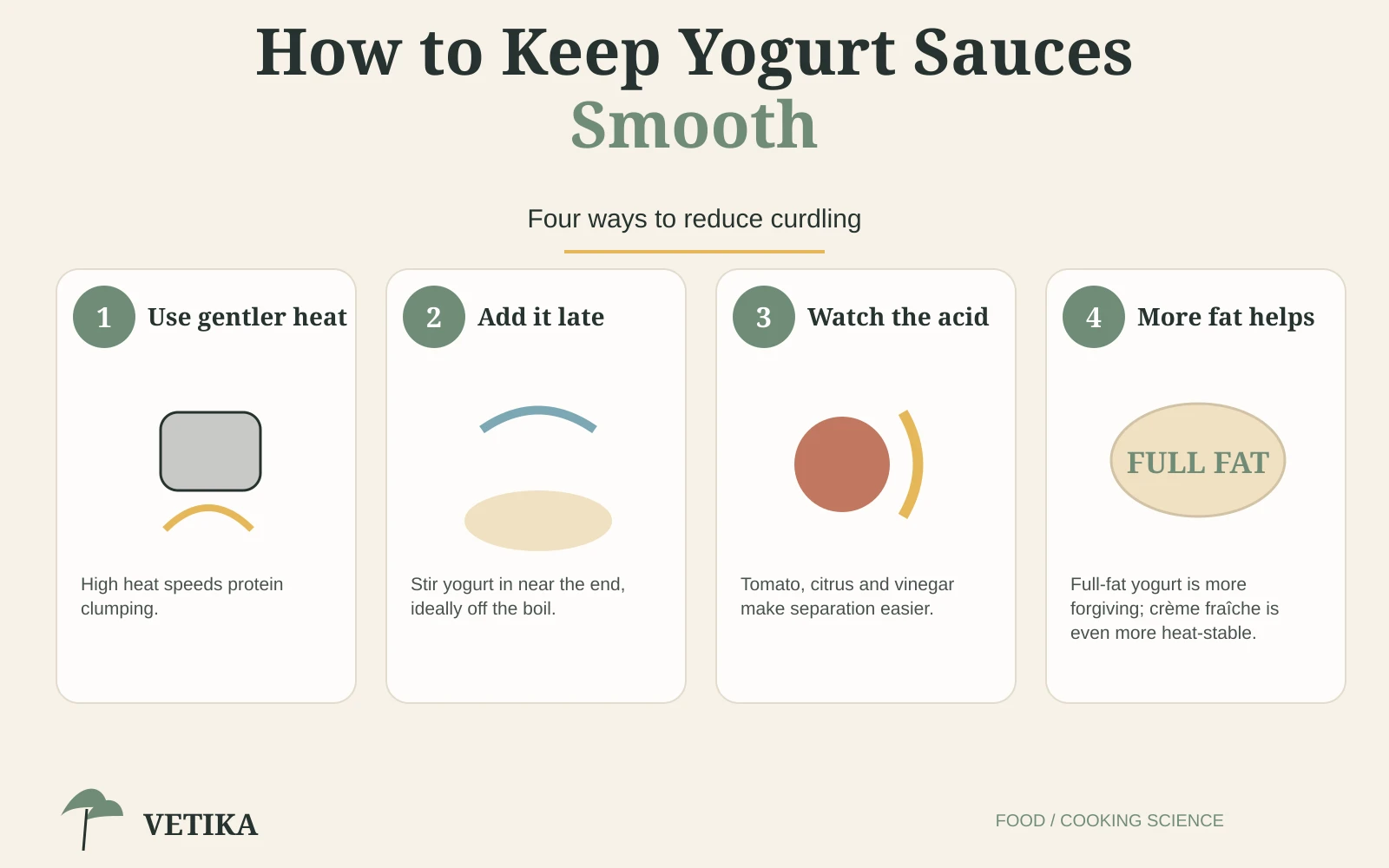
1. Use gentler heat
Do not boil yogurt aggressively once it has been added. High heat accelerates the clumping process.
2. Add yogurt near the end
The source recommends adding yogurt after the main cooking has finished or when the dish has cooled away from a strong simmer. This reduces the time the protein network spends under stress.
3. Respect acidic ingredients
Tomatoes, lemon, vinegar and fruit can all make separation more likely. The more acidic the dish, the more gently you should treat the yogurt.
4. Choose a more forgiving dairy product when needed
Full-fat yogurt tolerates heat better than low-fat yogurt. The source also points to crème fraîche as an even more heat-stable alternative because of its much higher fat content.
Is curdled yogurt unsafe?
The source discussion is about texture, not food safety. A sauce curdling because of heat and acid is a structural change. It may look unattractive and feel grainy, but the visual separation itself is not presented in the book as a sign of spoilage.
This distinction matters because “curdled” and “spoiled” are not the same concept.
Can you fix a curdled yogurt sauce?
The book focuses on prevention rather than a guaranteed rescue. Once the protein network has tightened into visible curds, simply stirring harder does not restore the original fine structure.
That is why the best strategy is to manage the conditions before separation happens: lower heat, add late, avoid prolonged boiling and choose a more stable dairy base when the dish is very acidic.
Why crème fraîche behaves differently
The source describes crème fraîche as a fermented cream with about 30% fat. That high fat level interferes with casein proteins enough that the product can tolerate heating with acidic ingredients far better than yogurt or light cream.
The trade-off is obvious: it is richer and changes the flavour and nutritional profile of the dish. But from a purely cooking-science perspective, it is a more stable system.
What this teaches us about sauces
A smooth dairy sauce is not simply “liquid plus dairy.” It is a structure in which proteins, water and fat are interacting in a particular balance.
Heat changes that balance. Acid changes it. Fat changes it.
Once you start seeing dairy this way, a lot of kitchen behaviour becomes easier to predict. Low-fat cream splits more easily. Yogurt dislikes boiling in acidic sauces. Crème fraîche survives conditions that would break lighter dairy products.
The common thread is protein stability.
Kitchen takeaways
If you want yogurt to stay smooth in a hot dish:
- lower the heat before adding it;
- add it near the end;
- be especially careful in tomato-, citrus- or vinegar-rich dishes;
- choose full-fat yogurt when heat stability matters;
- consider crème fraîche when the dish needs to tolerate stronger heating.
The point is not to memorise a list of taboos. It is to remember what the yogurt is: a delicate protein gel. Treat it like one, and it behaves far better.
FAQs
Why does yogurt curdle in curry?
Usually because heat and acidity tighten the milk-protein network until it forms visible clumps and separates from the watery phase.
Do spices make yogurt curdle?
The source says the main issue is not the spices themselves but acidic ingredients and heat.
Is full-fat yogurt better for cooking?
It is generally more heat-tolerant because fat globules interfere with protein clumping.
When should yogurt be added to a hot dish?
The source recommends adding it toward the end, when the dish is no longer at a strong simmer.
Why is crème fraîche more stable than yogurt?
Its higher fat content makes it harder for casein proteins to clump together when heated, especially in acidic dishes.