
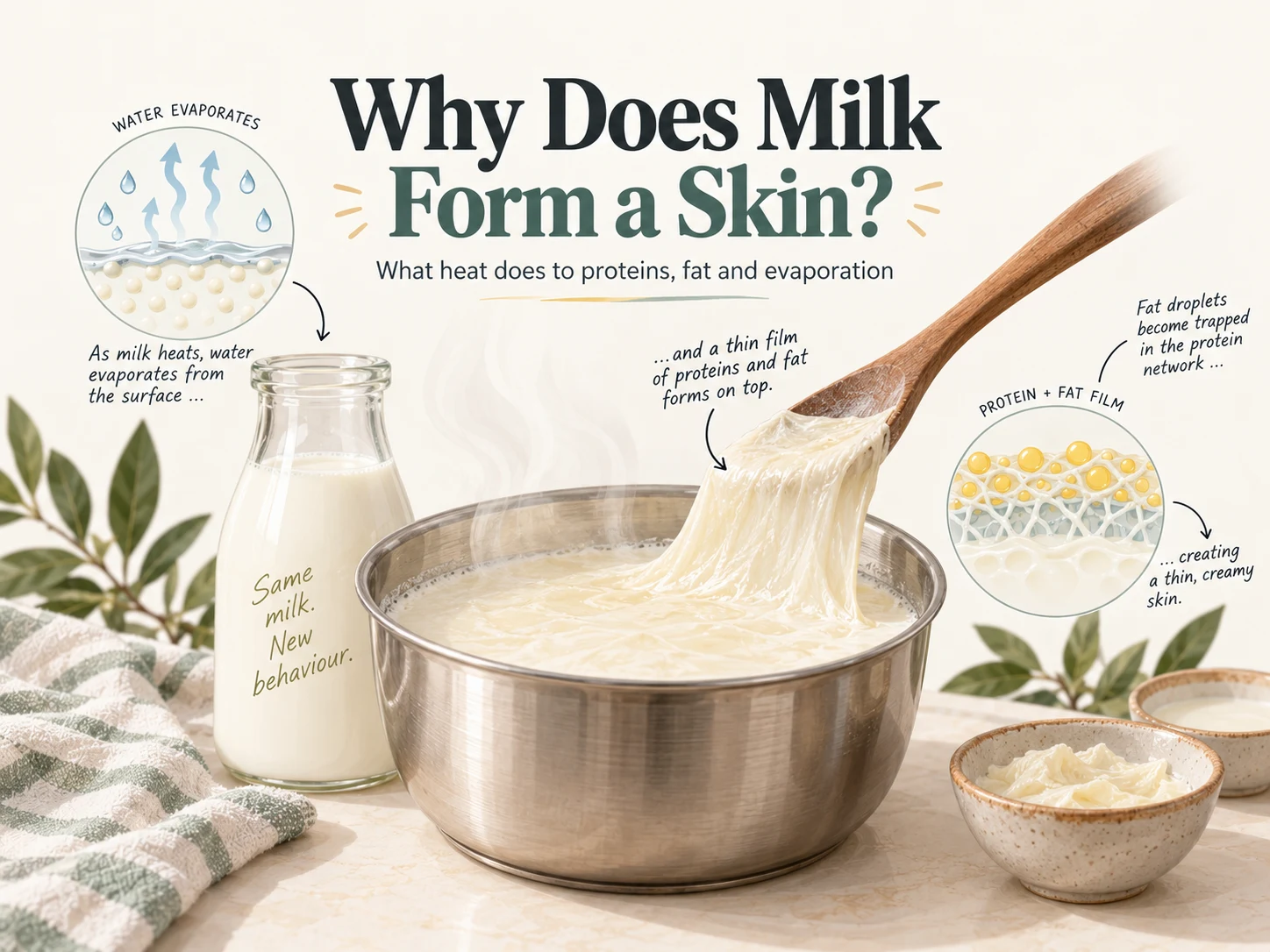
Heat a pan of milk gently and wait a little too long, and the surface starts doing something strange. A delicate film appears. Lift it with a spoon and it stretches into a thin sheet that feels almost separate from the milk beneath it.
Some people love it. Some people hate it. Either way, it is one of the most familiar little phenomena in the kitchen.
Milk skin forms because heating and evaporation change what is happening at the surface. As water leaves, proteins and fat become more concentrated near the top. Those components then link together into a thin film.
The short answer
Milk forms a skin because water evaporates from the surface as the milk heats. That leaves the surface layer richer in proteins and fat. Those molecules gather together and create a thin, cohesive film.
The skin is therefore a surface phenomenon. It is not a separate ingredient suddenly appearing from nowhere. It is milk reorganising itself at the boundary between liquid and air.
Why the surface matters
The top of heated milk is a special place. It is where the milk meets the air, where steam escapes and where the composition of the liquid changes first.
Because water can leave from the surface, the top becomes more concentrated than the liquid below. That difference creates the conditions for a film to form.
What the skin is made of
Milk skin is mainly associated with proteins and fat. As the surface becomes more concentrated, proteins interact more strongly and fat droplets can become incorporated into the developing network. The result is a thin, creamy, slightly elastic layer.
The precise feel of that layer depends on the milk and the heating conditions, but the basic mechanism remains the same.
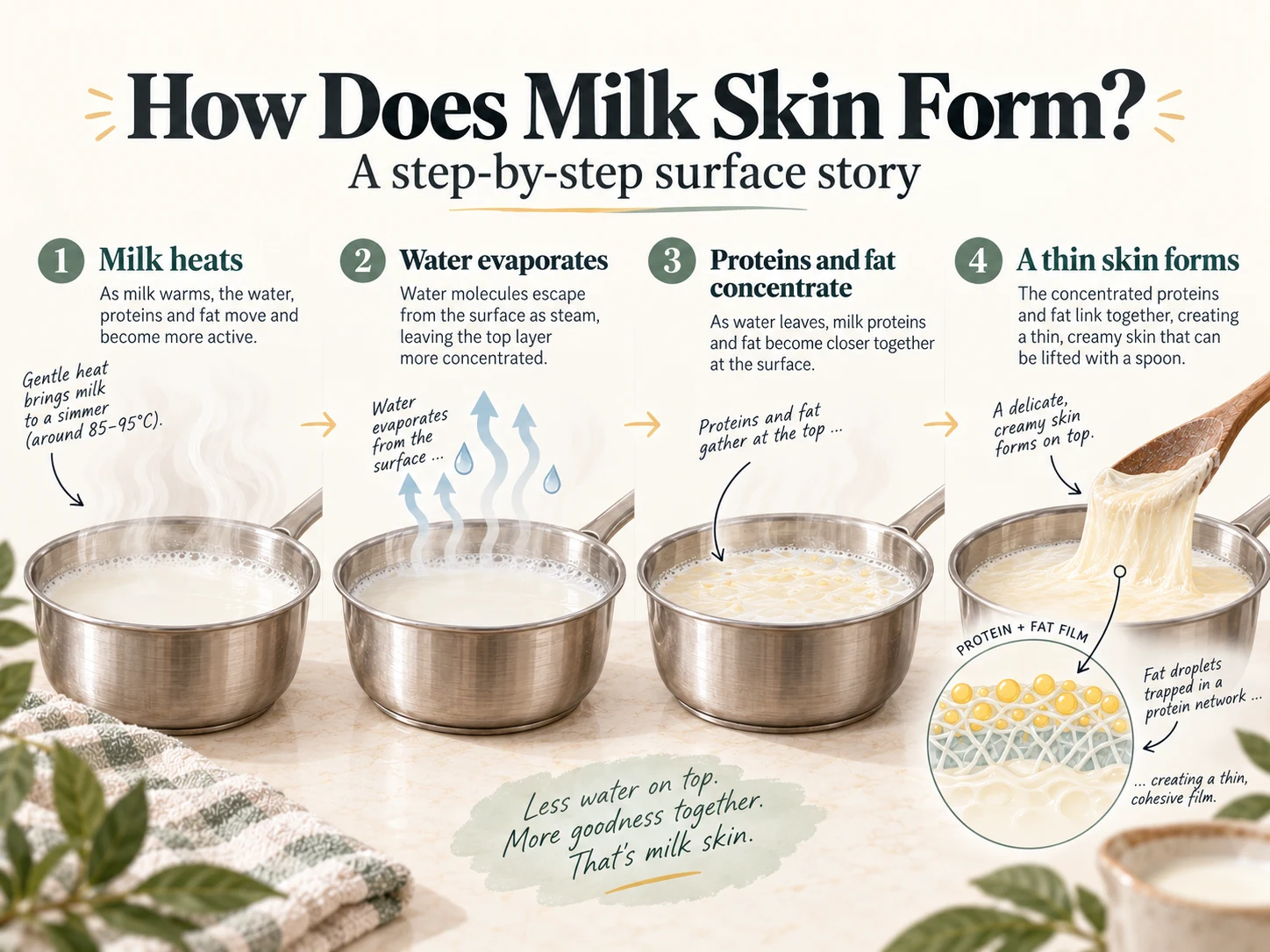
How the skin forms step by step
- The milk heats.
- Water begins evaporating from the surface.
- Proteins and fat become more concentrated at the top.
- They link together into a film.
It is a beautifully compact example of how evaporation changes texture.
Why stirring delays the skin
Stirring keeps disrupting the developing surface and mixes the top layer back into the rest of the milk. That makes it harder for a continuous film to establish itself. This is why milk left still forms a skin more readily than milk that is constantly agitated.
Does temperature matter?
Yes. Gentle heating toward a simmer encourages the process because it increases evaporation and changes how proteins behave. Too violent a boil, however, introduces more turbulence and can create a mess for other reasons.
For many practical purposes, the most useful advice is simply this: a hot, still surface is exactly what milk skin likes.
Is milk skin the same as cream?
Not exactly. Cream is a fat-rich portion of milk. Milk skin is a surface film formed by the combined effects of heat, evaporation, proteins and fat. Fat is part of the story, but it is not the whole story.
Why do some people notice it more than others?
Because it is highly visible and highly tactile. It changes the feel of a drink or sauce in a very noticeable way, so even people who know nothing about the chemistry instantly recognise that something has happened.
It is one of those perfect cooking-science moments in which the microscopic explanation and the sensory experience line up beautifully.
How to reduce or avoid milk skin
If you do not want it:
- stir the milk more often;
- cover the surface with something in contact with it once heated, if appropriate for the preparation;
- avoid leaving hot milk standing undisturbed;
- use the milk soon after heating.
Different kitchen contexts call for different tactics, but all of them work by stopping or disrupting the surface film.
Why this article belongs near emulsions and foams
Milk skin is not exactly an emulsion story or a foam story, but it sits near both. Like emulsions, it reminds us that fat distribution matters. Like foams, it shows what happens when proteins reorganise at interfaces.
That makes How Do Emulsions Actually Work? and Why Do Egg Whites Turn Into Foam? excellent internal links from this piece.
Kitchen takeaways
Milk skin forms because the top layer of heated milk is changing composition. Water leaves, proteins and fat concentrate, and a surface network forms.
Once you see the process that way, the skin stops being odd. It becomes a clear, visible sign that heat, evaporation and structure are interacting right in front of you.
FAQs
What is milk skin made of?
It is mainly a thin surface film involving milk proteins and fat, created as evaporation concentrates those components at the top.
Why does stirring stop skin from forming so easily?
Because it repeatedly breaks the surface and mixes the concentrated top layer back into the milk.
Does boiled milk always form a skin?
Hot milk left standing still is very prone to it, though the exact thickness depends on the milk and the conditions.
Is milk skin harmful?
No. It is simply a textural consequence of heating milk.
Can you stop it completely?
You can reduce it significantly by stirring, using the milk promptly and avoiding leaving the surface undisturbed.
What article should this link to next?
The best next click is How Do Emulsions Actually Work?, followed by Why Do Egg Whites Turn Into Foam? to continue the theme of proteins shaping texture.