
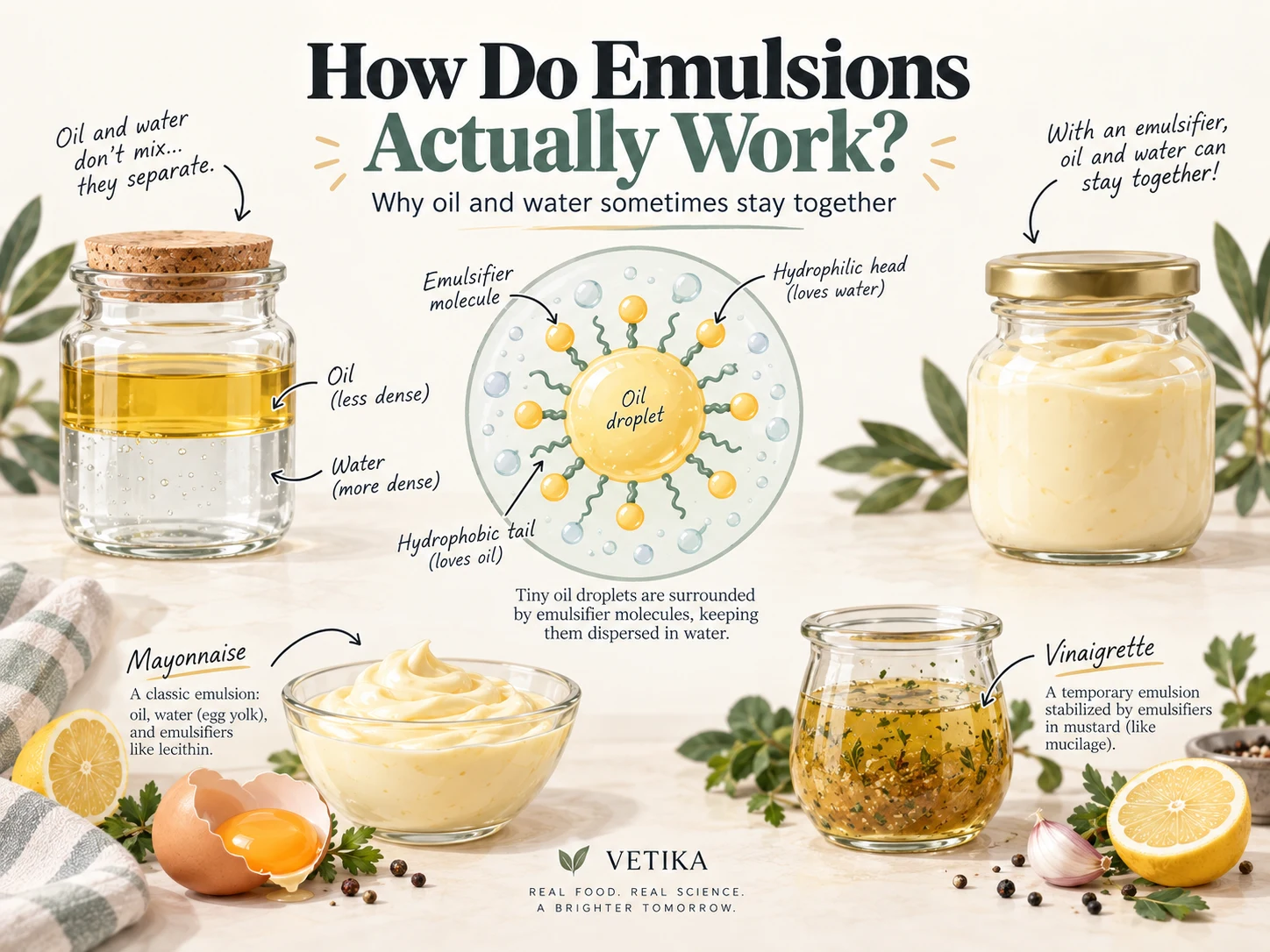
Oil and water are famous for not getting along. Shake them together and you can briefly create the illusion of harmony, but the peace never lasts. Give the jar a little time and the oil rises, the water falls, and the two parts go back to behaving like themselves.
So why does mayonnaise hold? Why can milk look uniform? Why does a vinaigrette appear creamy for a moment before separating again?
The answer is the emulsion: one of the most useful and elegant structures in everyday cooking.
What is an emulsion?
An emulsion is a mixture in which droplets of one liquid are dispersed through another liquid that would normally prefer to separate from it. In cooking, the classic pair is oil and water.
The key word is dispersed. In a true emulsion, one liquid is broken into very small droplets and spread through the other. As long as those droplets remain separate, the mixture behaves like a single substance. Once they begin merging, the emulsion weakens and eventually breaks.
Why oil and water separate in the first place
Water molecules are strongly attracted to one another, and oils prefer their own kind. When the two are mixed, the system naturally reorganises into a lower-energy arrangement: water with water, oil with oil. Density helps decide which layer sits where, but the deeper story is compatibility.
If you simply pour oil and water into a container and leave them alone, they will form layers. That is the default state.
What changes when you make an emulsion
An emulsion works by defeating that default arrangement for long enough to create a useful texture. Mechanical action—whisking, shaking, blending—breaks one liquid into droplets. The smaller the droplets become, the more stable and creamy the mixture can feel.
But physical force alone rarely gives lasting stability. You also need help at the boundary between the droplets and the surrounding liquid.
What emulsifiers actually do
Emulsifiers are molecules that are comfortable interacting with both phases. One part of the molecule is attracted to water, while another part is attracted to oil. Because of this two-sided behaviour, emulsifiers gather around droplets and help keep them apart.
In mayonnaise, lecithin from egg yolk does much of this work. In a vinaigrette, mustard can help. In dairy systems, proteins and fat structures contribute to stability in different ways.
A good way to picture this is to imagine countless tiny bodyguards surrounding each oil droplet. Their presence does not make oil and water identical, but it does make coexistence possible.
What makes an emulsion stable?
Stability depends on several things working together:
- Small droplets. Smaller droplets are less eager to separate quickly.
- Enough emulsifier. If there is not enough material protecting the droplets, they can merge.
- The right balance of phases. Too much of one phase, added too quickly, can overwhelm the system.
- Suitable handling. Some emulsions respond badly to excessive heat, violent treatment or long standing.
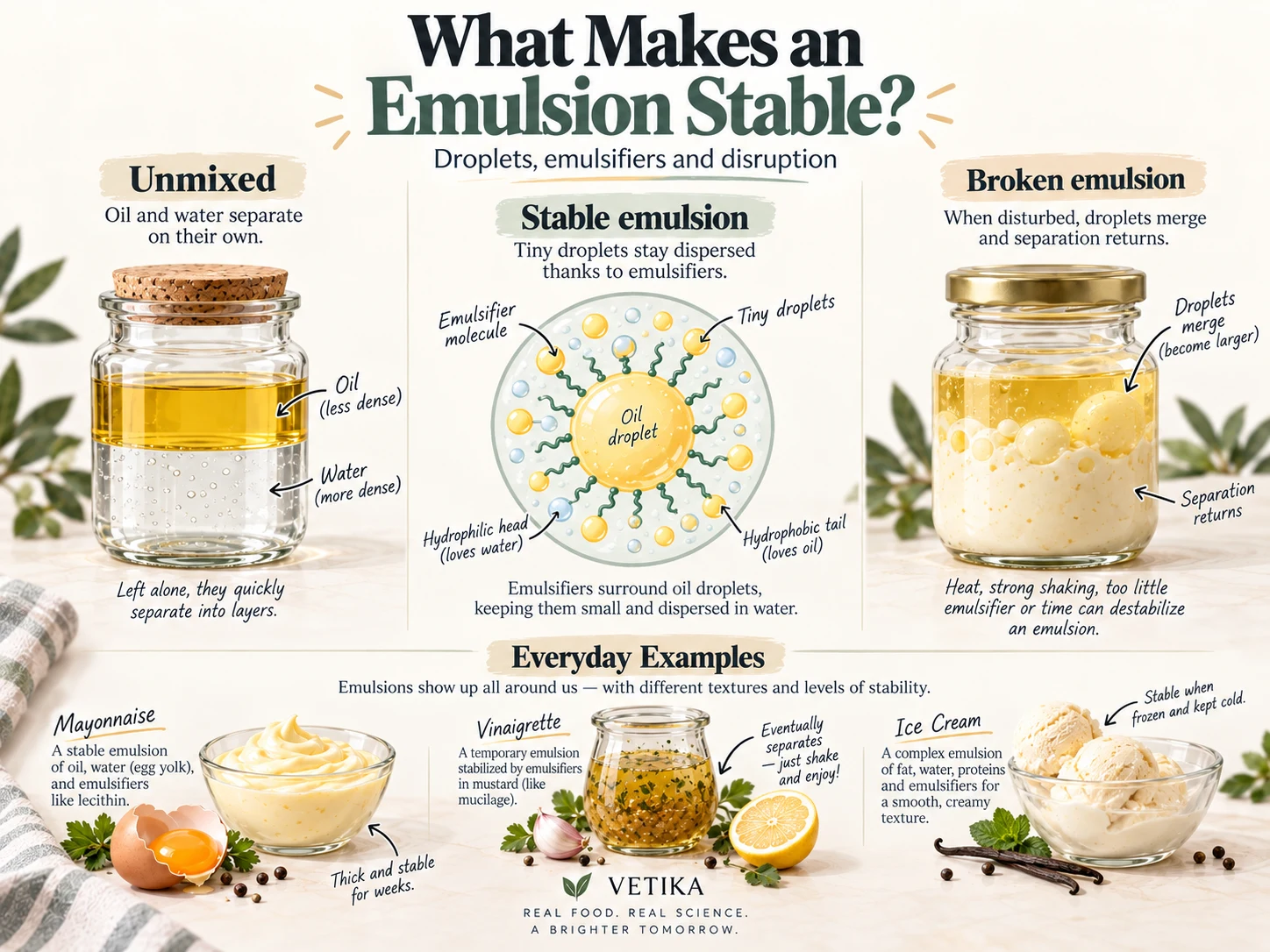
Stable, temporary and broken emulsions
Not all emulsions are equally durable.
Stable emulsions
These hold together for a long time because the droplets are very fine and well-protected. Mayonnaise is the classic example.
Temporary emulsions
These hold only briefly before they start separating again. A simple oil-and-vinegar vinaigrette is a familiar case. Shake it and it looks unified; let it rest and the layers return.
Broken emulsions
These are emulsions that have lost their structure. The droplets merge into larger droplets, separation reappears and the mixture becomes oily, curdled or grainy.
That is exactly what happens when mayonnaise splits.
Where emulsions show up in the kitchen
Emulsions are everywhere once you know how to spot them.
- Mayonnaise: a thick oil-in-water emulsion held by egg-yolk emulsifiers.
- Vinaigrette: usually a temporary emulsion, often helped by mustard.
- Milk: a naturally complex colloidal system with fat and proteins contributing to a uniform appearance.
- Ice cream: a far more complicated system involving fat, water, proteins, air and freezing.
- Cream sauces: many rely on fat being properly dispersed for smoothness.
Why emulsions feel creamy
Emulsions do not just change appearance; they change mouthfeel. Tiny droplets interact with the way a sauce flows, thickens and coats the palate. That is why mayonnaise feels rich and why a good vinaigrette can feel smoother and more integrated than bare oil and vinegar.
Again, structure is the hidden story.
What causes an emulsion to break?
Emulsions break when their droplets stop staying apart. This can happen because:
- the droplets are too large;
- the emulsifier is insufficient or poorly distributed;
- the ratio of oil to water becomes unbalanced;
- heat changes the system;
- or time allows separation to creep back in.
In practice, the most important lesson for home cooks is not to dump ingredients in blindly. Build the emulsion, then feed it.
A useful contrast: emulsions and foams
Emulsions are one kind of dispersed system. Foams are another. In an emulsion, droplets of liquid are dispersed in a liquid. In a foam, bubbles of gas are dispersed in a liquid or semi-solid structure.
That makes Why Do Egg Whites Turn Into Foam? a perfect companion article. The ingredients may differ, but the deeper theme is similar: tiny structures create textures that feel almost magical from the outside.
Kitchen takeaways
If you remember nothing else, remember this: oil and water do not stop disliking each other. An emulsion is simply a carefully managed truce.
To make that truce last, you need:
- small droplets;
- an emulsifier;
- the right proportions;
- and gentle, intelligent handling.
Once you know that, mayonnaise, salad dressing and a host of other kitchen textures stop feeling mysterious.
FAQs
What is the simplest definition of an emulsion?
An emulsion is a mixture in which droplets of one liquid are dispersed through another liquid that would normally separate from it.
Why do oil and water separate?
Their molecules prefer interacting with their own kind, so the system naturally rearranges itself into separate phases.
What does an emulsifier do?
It helps droplets remain dispersed by interacting with both oil and water and reducing the tendency of droplets to merge.
Is mayonnaise a stable emulsion?
Yes. When made properly, it is one of the classic examples of a relatively stable kitchen emulsion.
Is vinaigrette an emulsion?
Yes, usually a temporary one. It often separates again unless re-shaken or helped by ingredients such as mustard.
What article should this link to next?
The most natural next stop is Why Does Mayonnaise Split?, followed by Why Does Milk Form a Skin? as another example of ingredients behaving differently at boundaries and surfaces.