
If you have ever watched a bowl of mayonnaise go from silky and glossy to greasy, grainy and oddly thin, you have seen one of cooking’s most revealing little failures. Split mayonnaise feels dramatic because it looks as though the ingredients have suddenly stopped cooperating. In reality, that is exactly what has happened.
Mayonnaise is an emulsion: a sauce in which tiny droplets of oil are dispersed through a water-based phase and held there by emulsifiers, especially lecithin from egg yolk. When that microscopic structure collapses, the oil droplets begin to merge, the mixture loses its body, and the sauce “splits.”
The good news is that split mayonnaise is not a mysterious curse and it usually is not the end of lunch. Once you understand what is happening inside the bowl, mayonnaise becomes easier to make, easier to diagnose and—most importantly—much easier to rescue.
The short answer
Mayonnaise splits because the oil droplets inside the sauce stop staying separate. Instead of remaining evenly dispersed, they begin colliding and merging into larger droplets. As that happens, the emulsion weakens, the structure collapses and the oil starts separating from the water-based phase.
In practice, that breakdown is usually triggered by one of three things: adding the oil too quickly, building the emulsion before the base is ready, or making the mixture work harder than necessary with very cold ingredients.
What mayonnaise really is
A spoonful of mayonnaise looks smooth, but its smoothness is deceptive. Underneath that creamy texture lies an enormous number of microscopic oil droplets suspended in a much smaller amount of watery liquid. The magic of the sauce is not that oil disappears. It is that the oil is broken up so finely that the mixture behaves like one thick, unified whole.
This is why mayonnaise can contain a great deal of oil and still feel creamy rather than greasy. Structure matters as much as ingredients. The oil is still there, but it has been reorganised.
Egg yolk makes that possible. Lecithin and other surface-active components in the yolk sit at the boundary between oil and water, lowering tension and helping the droplets stay apart. Whisking then does the mechanical work of tearing the oil into smaller and smaller droplets and distributing them through the liquid.
If you want the bigger picture behind that process, this article should naturally link to How Do Emulsions Actually Work?
Why mayonnaise becomes thick
At first, the mixture is loose. As more and more tiny oil droplets are created and packed into the sauce, movement inside the mixture becomes harder. The droplets crowd one another, the sauce resists flow more strongly, and the mayonnaise thickens.
This is an encouraging sign while you work. A mayonnaise that is becoming opaque, creamy and gradually firmer is usually telling you the emulsion is developing well.
What it means when mayonnaise splits
A split mayonnaise is not “bad ingredients.” It is a bad structure.
When the emulsion breaks, the tiny droplets that once remained separate start fusing together. As they grow larger, they become harder to keep dispersed. The glossy cream turns into a mixture with visible oil, curdled-looking clumps or a texture that suddenly seems loose and unstable.
This is the crucial mental shift: the problem is not that oil and water can never mix. It is that they only stay mixed while the emulsion is being properly supported.
The most common cause: adding the oil too fast
This is the classic problem because it strikes at the exact moment the sauce is most fragile. Early in the process, you do not yet have a strong, mature emulsion. You are building one. If too much oil arrives before the existing droplets have been properly incorporated, the base gets overwhelmed. Larger droplets survive, then begin merging, and the sauce breaks.
That is why the start matters so much. The first additions of oil should be slow and controlled. Once the sauce has thickened and the emulsion is clearly established, it becomes more forgiving.
Do cold ingredients make it worse?
They can. Very cold ingredients do not automatically ruin mayonnaise, but they can make emulsification slower and a little less cooperative. When the goal is to build a delicate structure, it helps if the yolk and other components are not ice cold. Room-temperature ingredients simply make the process easier to control.
What about whisking direction?
Whisking clockwise instead of anticlockwise is not the decisive factor. The important job of whisking is to break up the oil and distribute it evenly. The real rules are structural, not superstitious: add the oil progressively, whisk consistently and give each addition time to disappear into the sauce before adding more.
How to tell the emulsion is in trouble
The sauce often gives a warning before it fully breaks. Watch for these signs:
- oily streaks or shiny pools on the surface;
- a mixture that suddenly becomes thinner instead of thicker;
- a grainy or curdled appearance;
- droplets that refuse to blend in.
If you notice these signs, stop adding more oil. Continuing to pour in oil usually makes the problem worse.
How to fix split mayonnaise
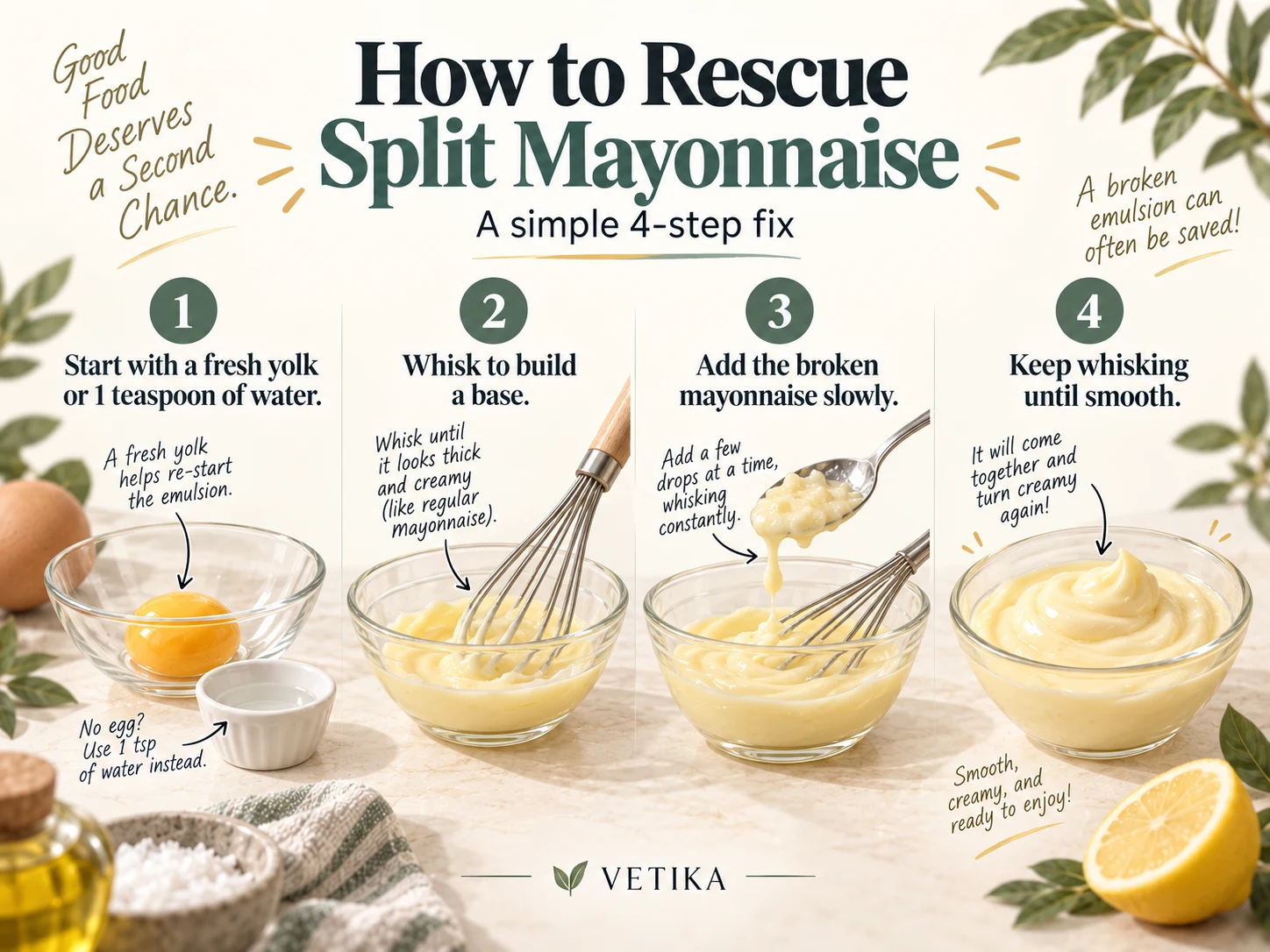
The principle of the rescue is simple: you must build or rebuild a stable emulsion and then feed the broken mixture into it slowly.
There are two practical ways to do that.
Method 1: start with a teaspoon of water
If the mayonnaise has only just started to split, whisking in a teaspoon of water can be enough to help the structure reorganise. It gives the droplets a more workable environment and may restore smoothness.
Method 2: start over with a fresh yolk
If the sauce is more badly broken, begin a new emulsion in a clean bowl with a fresh yolk. Whisk the yolk briefly, then add the broken mayonnaise a little at a time, as if the failed sauce were your oil. The fresh yolk provides new emulsifiers, and the slow addition gives the droplets a second chance to become properly dispersed.
Why the rescue works
Rescue succeeds because it does not “glue” a broken sauce back together by force. It creates a new stable emulsion and gradually reincorporates the failed mixture into it. That is the same logic as the original recipe: build first, then feed the structure.
Once you understand that, mayonnaise stops feeling temperamental and starts feeling logical.
Kitchen takeaways
If you want reliable mayonnaise, remember these practical rules:
- begin with a strong base of yolk and water-based ingredients;
- add the first oil especially slowly;
- look for the sauce to thicken steadily;
- stop immediately if it becomes oily or loose;
- rescue it with water or a fresh yolk rather than throwing it away.
Mayonnaise is one of the clearest examples of a larger truth in cooking science: ingredients matter, but the structure you build with them matters just as much.
FAQs
Why did my mayonnaise suddenly turn liquid?
It likely began to split. When the oil droplets merge into larger droplets, the emulsion loses its thick structure and the sauce becomes thinner.
Can split mayonnaise be saved?
Usually yes. A teaspoon of water may help if the split is minor; otherwise, start a new emulsion with a fresh yolk and whisk the broken mayonnaise into it slowly.
Does the kind of oil matter?
The mechanics of emulsification are similar regardless of the oil, though flavour, viscosity and temperature can subtly affect handling. Mild oils usually make the sauce easier to enjoy and easier to season.
Is mayonnaise mostly egg?
No. Egg yolk is essential, but a finished mayonnaise contains a large proportion of oil. The creamy texture comes from how that oil is dispersed.
What article should this link to next?
The strongest next click is How Do Emulsions Actually Work?, followed by Why Do Egg Whites Turn Into Foam? for another example of how structure changes texture.