
Few transformations in the kitchen look more magical than this one: clear, slippery egg whites suddenly become white, billowy and full of volume. You start with a liquid that barely seems to have any body at all, and a few minutes later you have a foam strong enough to lift into peaks.
It feels like a trick. In reality, it is a structural rewrite.
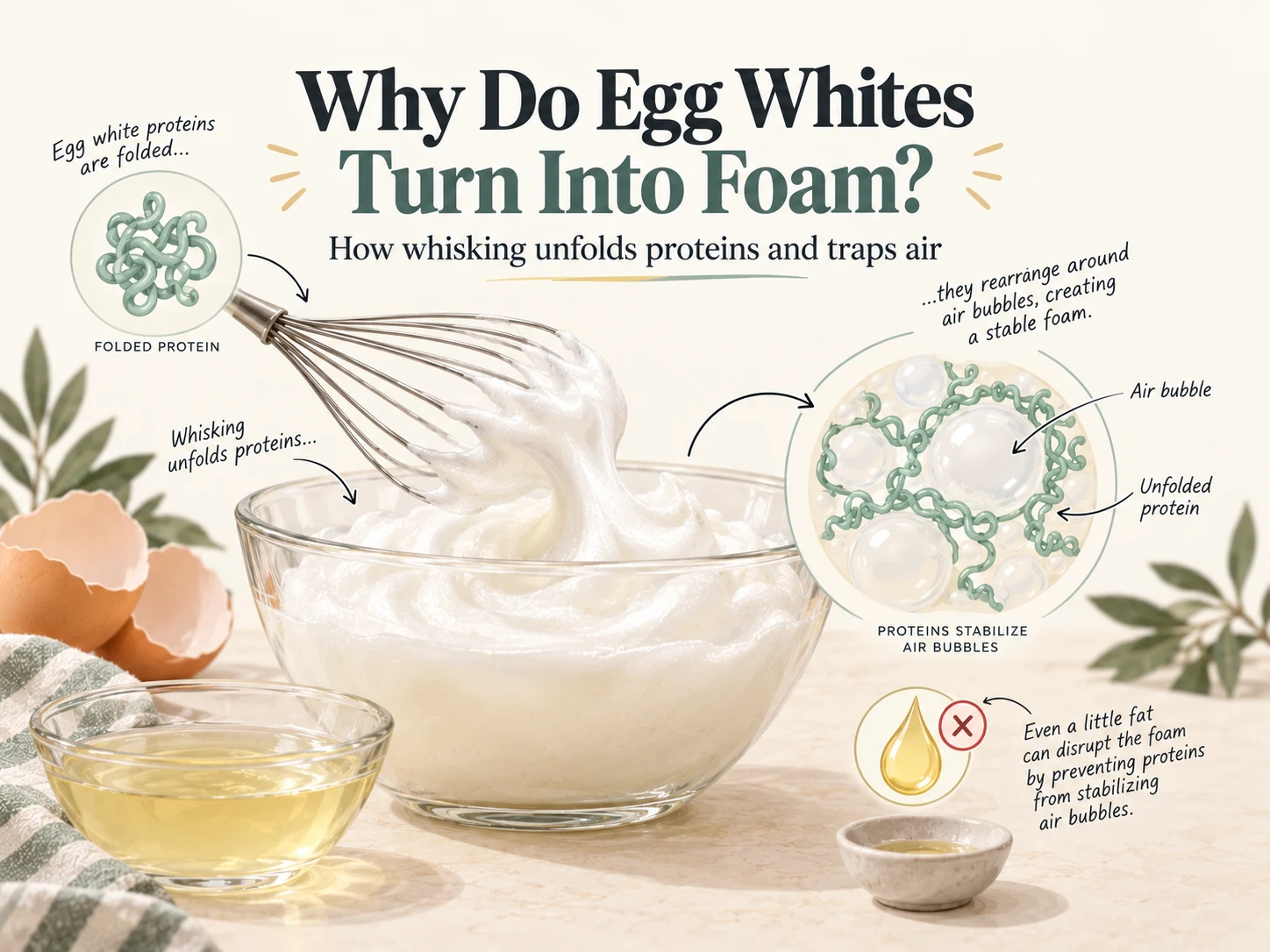
Egg-white foam forms because whisking unfolds proteins and forces air into the liquid at the same time. Those proteins then gather around the new air bubbles, helping stabilise the foam and keep the bubbles from collapsing immediately.
The short answer
Egg whites turn into foam because mechanical action unfolds their proteins and traps air. The unfolded proteins gather around the air bubbles and create a network that helps hold the foam in place.
This is why a bowl of raw whites can become a meringue-like foam: the whisk is not just “mixing.” It is building a new structure.
What egg whites are made of
Egg whites are mostly water, but that water contains dissolved proteins. In their natural state, many of those proteins are folded into compact shapes. As long as they remain folded and undisturbed, the egg white behaves like a simple liquid.
Whisking changes that. The agitation stretches and unfolds the proteins, exposing parts of them that can interact more readily with both water and air.
How whisking creates foam
A whisk does two jobs at once:
- it beats air into the liquid;
- it denatures, or unfolds, proteins.
Once unfolded, the proteins move to the surface of the bubbles and begin linking together into a network. That network reinforces the thin liquid films around each bubble and helps stop them from bursting immediately.
That is why foam gains both volume and staying power as whisking continues—up to a point.
Why the foam becomes white
Raw egg white is relatively transparent. Foam is full of tiny bubbles and thin films that scatter light in many directions. The result is a mass that looks white and opaque.
This is a good example of how physical structure changes what we see, even though the ingredient itself is still the same ingredient.
Soft peaks, firm peaks and beyond
As the foam develops, the bubble structure becomes finer and the protein network stronger.
- Foamy stage: large bubbles, unstable, little volume.
- Soft peaks: smoother foam, more volume, peaks bend over.
- Firm peaks: stronger structure, peaks stand taller.
- Over-whipped stage: dry, clumpy or grainy foam.
A useful article should help readers understand that these stages are not arbitrary recipe language. They reflect the condition of the protein network.
What ruins egg-white foam?
Egg whites are generous, but not infinitely forgiving.
1. Fat or yolk
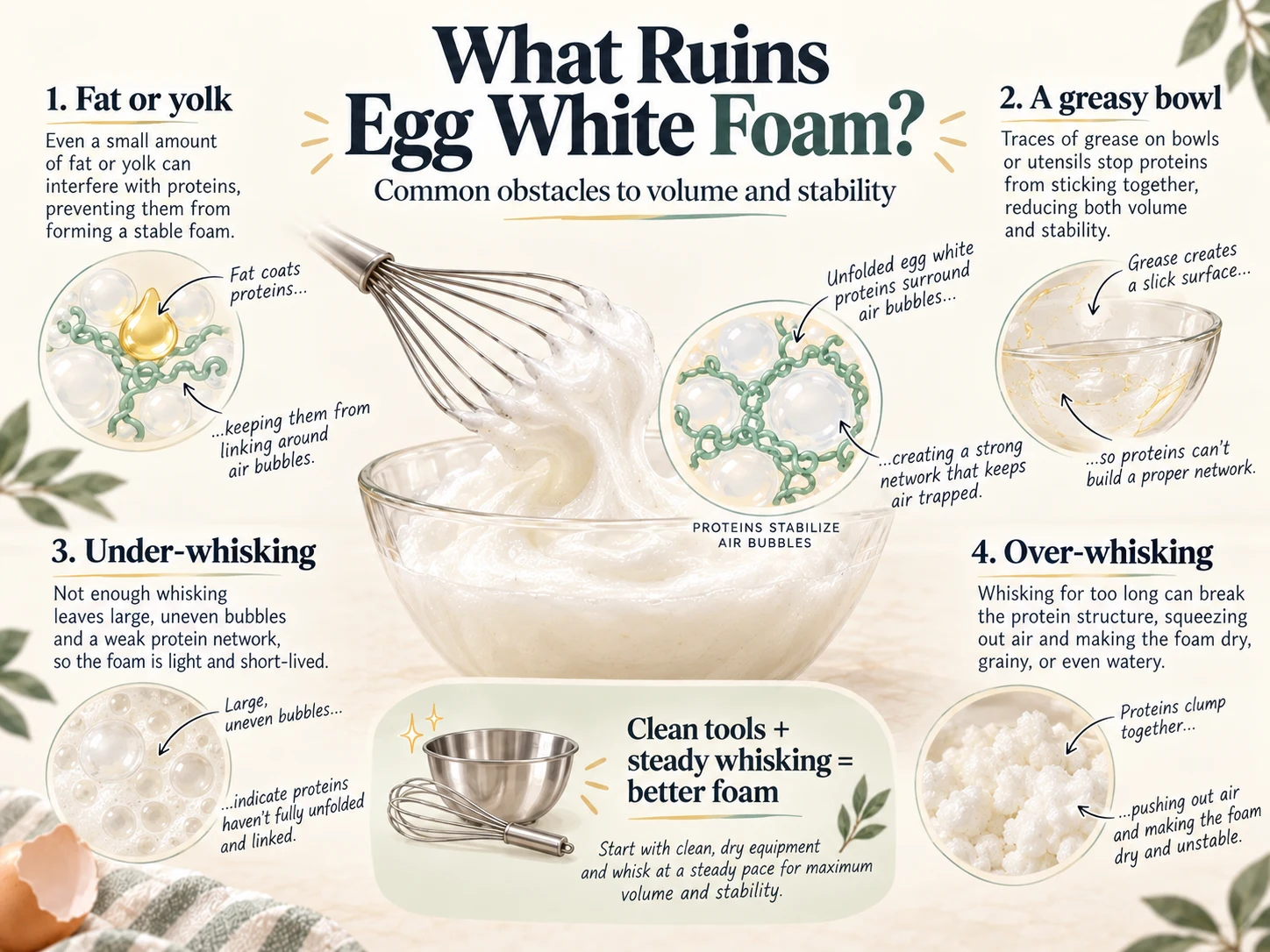
Even a tiny amount of fat can interfere with the proteins’ ability to stabilise bubbles. This is why a trace of yolk can sabotage volume.
2. A greasy bowl
Grease on the bowl or whisk creates the same kind of problem. Proteins struggle to build the network you need.
3. Under-whisking
If the proteins have not unfolded enough and the bubbles are still large and uneven, the foam remains weak.
4. Over-whisking
Keep going too long and the network tightens too far. Moisture gets squeezed out, the foam becomes dry and grainy, and stability suffers.
Why sugar and acid matter
In many recipes, sugar and acid are not just flavouring choices.
Acid—such as cream of tartar or lemon juice—can help the proteins form a more stable network by slightly adjusting the conditions in the mixture.
Sugar can help stabilise the foam too, though it also slows down the whipping process because it changes how easily proteins and water interact.
This kind of detail is worth including because it turns recipe instructions into understanding rather than ritual.
Why fresh whites and older whites behave differently
Slightly older egg whites are often thinner, which can make them easier to whip initially. Very fresh eggs, on the other hand, often have thicker whites. The “best” choice can depend on the job, which is one reason this article links naturally to How Can You Tell if an Egg Is Fresh?
Foams versus emulsions
Egg whites give us another excellent contrast with egg yolks. The yolk helps create emulsions such as mayonnaise; the white helps create foams. One part of the egg teaches us about oil droplets in water, the other about air bubbles in liquid.
Few ingredients are better than eggs for demonstrating how structure creates texture.
Kitchen takeaways
For better egg-white foam:
- use a clean, grease-free bowl and whisk;
- keep yolk contamination out;
- whisk steadily rather than frantically;
- stop at the stage the recipe actually needs;
- remember that sugar and acid affect both speed and stability.
Once you understand that proteins are building a bubble-stabilising network, the whole process becomes much easier to control.
FAQs
Why do egg whites turn white when whipped?
Because the foam contains countless tiny bubbles that scatter light, making the mixture look white and opaque.
Why does a little yolk ruin whipped egg whites?
Yolk contains fat, which interferes with the proteins’ ability to stabilise air bubbles.
Can you over-whip egg whites?
Yes. Over-whipping can make the foam dry, clumpy and less stable as the protein network tightens too much.
Does a greasy bowl matter?
Absolutely. Even traces of grease can reduce volume and stability.
What helps stabilise egg white foam?
Clean equipment, appropriate whisking, and in many recipes a little acid or sugar.
What article should this link to next?
The strongest next step is How Can You Tell if an Egg Is Fresh?, followed by Why Does Mayonnaise Split? to compare foams and emulsions.