
How to Make Perfect Scrambled Eggs: The Protein Science Behind Creamy Curds
Creamy scrambled eggs come down to protein coagulation, heat and timing. Learn why eggs turn rubbery, why stirring matters and when to stop cooking.
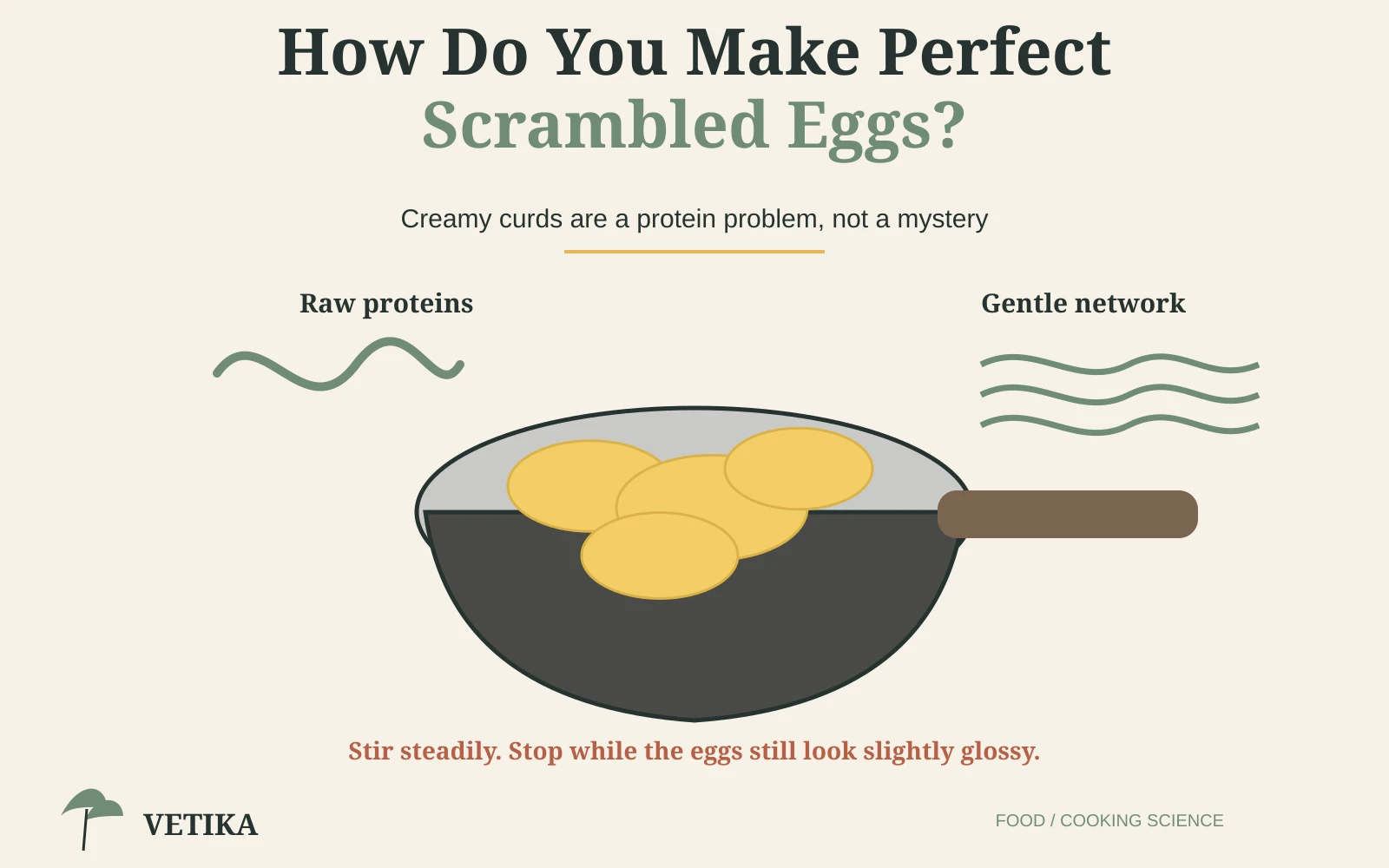
Scrambled eggs are one of the first things many people learn to cook and one of the easiest things to overcook. That combination is what makes them such a good piece of food science.
You are working with a mixture that can move from liquid to creamy curds to dry rubber in a surprisingly short time. The difference is not magic, secret ingredients or a chef’s special pan. It is protein coagulation and how quickly you let the network tighten.
The short answer
Scrambled eggs become creamy when heat unfolds egg proteins and lets them link into a loose network that traps water and fat. Stirring prevents that network from forming one solid mass, breaking it into soft curds instead.
Keep heating and the network tightens. Eventually it squeezes out moisture, making the eggs firm, dry and sometimes watery around the edges.
The trick is therefore simple to state and harder to practise: cook just enough, then stop.
What is changing inside the pan?
Before cooking, egg proteins are folded into compact shapes and float in a watery mixture alongside fat. Beating the eggs disperses everything more evenly but does not fully cook or set the proteins.
Heat changes that.
As the temperature rises, proteins begin to unfold. Once unfolded, they can connect with neighbouring proteins. Those connections gradually create a three-dimensional network through the egg.
The book notes that around 60°C / 140°F, protein networking becomes obvious and the mixture begins turning solid.
Why stirring matters
If you left the egg mixture completely still, the protein network would form one continuous mass. Stirring breaks that developing structure into curds.
How you stir helps determine texture:
- frequent stirring creates smaller, softer curds;
- less stirring allows larger pieces to form;
- aggressive high heat makes the whole process happen faster and gives you less time to stop at the creamy stage.
The important point is that stirring is not just moving food around so it does not stick. It is shaping the protein network.
From liquid egg to creamy curds
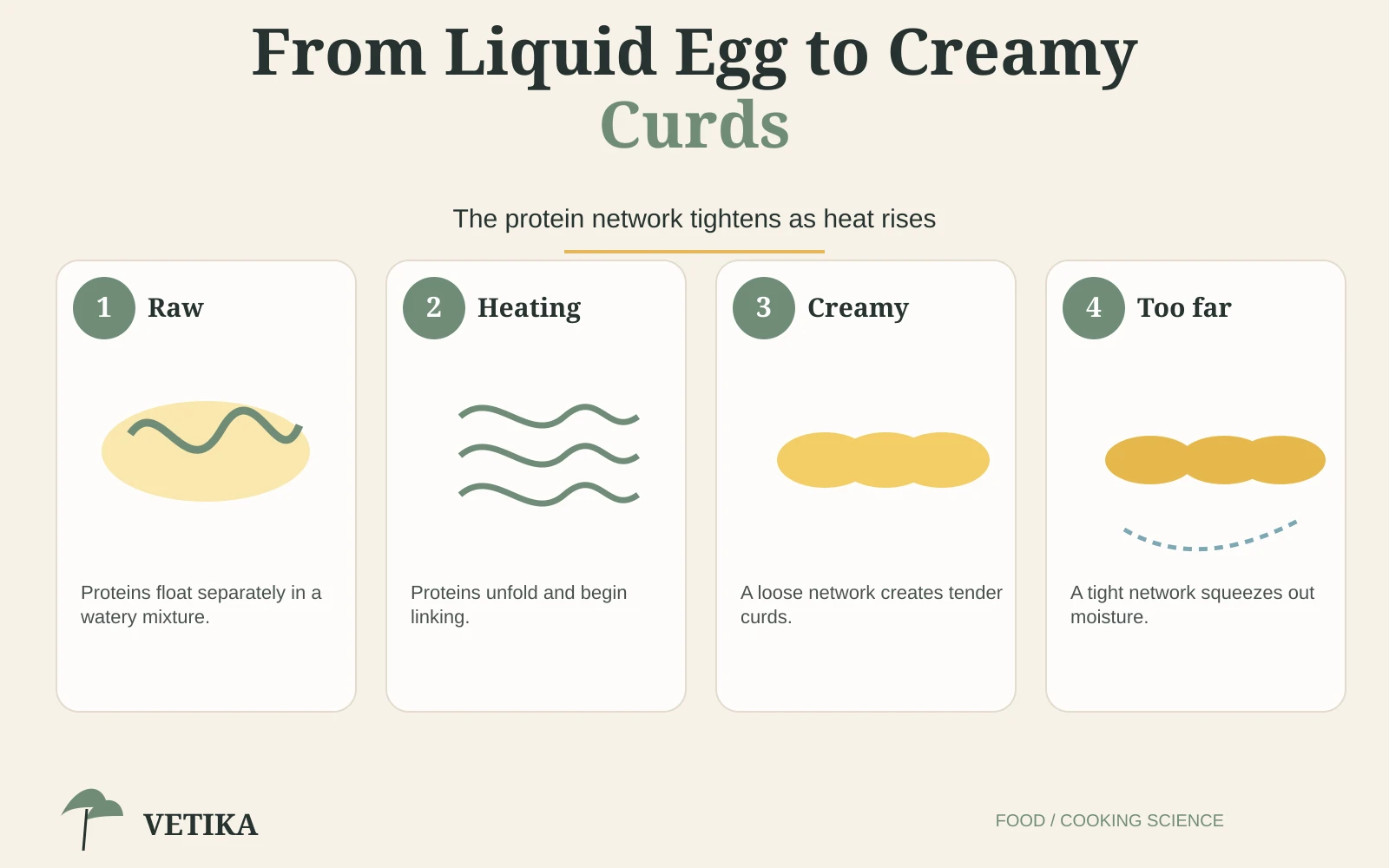
Stage 1: raw
Proteins are still largely folded and separate. The mixture flows freely.
Stage 2: heating
The proteins unfold and begin bumping into one another. The mixture starts thickening.
Stage 3: creamy
A loose network has formed, but it still holds plenty of moisture. This is the tender stage most people are chasing.
Stage 4: overcooked
The network becomes dense and tight. Water is forced out, curds become firmer, and the eggs lose their glossy softness.
Why high heat makes scrambled eggs harder to control
High heat is not automatically wrong, but it gives you a smaller margin for error. The pan surface can become hot enough to set proteins rapidly while the top of the eggs is still fluid.
That encourages dry patches and uneven curds unless you move quickly.
Gentler heat slows the process. Slower cooking gives you more time to stir, observe the texture and remove the pan before the eggs go too far.
This is why “low and slow” feels forgiving even though it is not a law of nature.
Why eggs keep cooking after you turn off the heat
The pan is still hot. So are the curds. Removing the pan from the burner stops new heat entering from below, but stored heat continues moving through the food.
That means you should usually stop cooking slightly before the eggs look completely finished. If you wait until they look perfect in the pan, the carryover heat can push them past perfect on the plate.
What fat does
Butter or oil helps in two ways. It lubricates the pan surface, reducing sticking, and adds richness to the mouthfeel.
The source notes that a little oil or butter helps stop egg proteins bonding directly to the metal. This is a useful reminder that sticking is also a protein problem: the same reactive proteins building your curds can interact with the hot pan.
Do you need milk or cream?
Not necessarily. Eggs can become creamy through controlled protein setting alone. Extra dairy changes flavour, dilution and the way the mixture heats, but it is not the fundamental reason scrambled eggs can be soft.
If you use it, think of it as a style choice rather than a rescue mechanism.
Should you salt eggs before cooking?
The source section focuses on heat and protein behaviour rather than salting timing, so this pack does not turn that into a hard rule. The important science here is the way proteins unfold, link and tighten as temperature rises.
That keeps the article faithful to what the source actually supports.
The best visual cue: gloss
Creamy scrambled eggs still look moist and slightly glossy. Dry eggs look matte and sharply separated.
That change in surface appearance is useful because it mirrors what is happening internally. The more water the protein network retains, the softer and shinier the curds appear.
A simple method that follows the science
- Beat the eggs until yolk and white are evenly dispersed.
- Warm a pan with a little butter or oil.
- Add the eggs and stir continuously or frequently, depending on the curd size you want.
- Keep the heat moderate enough that you can see the texture change.
- Remove the pan while the eggs are still a little softer than your ideal result.
- Serve immediately.
You do not need a mystical technique. You need to control how quickly the network forms.
The deeper lesson
Scrambled eggs are a perfect reminder that “doneness” is not a switch. Proteins change progressively. Creamy and rubbery scrambled eggs are not two completely different foods—they are two points on the same structural journey.
Understanding that gives you control. Instead of following a fixed time, you watch the network develop. Instead of trying to rescue dry curds with extra ingredients, you prevent the network from tightening too far in the first place.
FAQs
Why do scrambled eggs become rubbery?
Because continued heat causes the protein network to tighten, pushing out moisture and producing firmer curds.
Why should scrambled eggs be stirred?
Stirring breaks the developing protein network into curds and helps the mixture cook more evenly.
What temperature do egg proteins start to set?
The book describes noticeable network formation around 60°C / 140°F, though different egg proteins respond across a range of temperatures.
Does butter stop eggs sticking?
It helps by lubricating the pan and reducing direct protein-to-metal contact.
Why remove scrambled eggs before they look fully done?
Because residual heat in the pan and food continues cooking them after the burner is turned off.