
How to Cook Soft-Boiled Eggs with Runny Yolks: The Science of Timing and Temperature
Why can the white set while the yolk stays runny? Compare boiling, steaming and sous vide, and learn the temperatures that control soft-boiled eggs.
A soft-boiled egg looks simple until you try to make the exact one you have in mind. You want a white that is set enough to hold together, a yolk that is warm and flowing, and a narrow margin between “perfect” and “why is this suddenly hard-boiled?”
The reason that margin exists is that an egg is not one material. It contains several layers with different proteins, and those proteins set at different temperatures. Once you understand that, soft-boiled eggs stop being just a timing trick and become a small exercise in heat control.
The short answer
A runny-yolk egg works because the thick white sets at a lower temperature than the yolk, while the thin white needs slightly more heat. The book gives approximate setting points of 60°C for the thick white, 68°C for the yolk and 70°C for the thin white.
That staggered sequence is both the opportunity and the problem. You can set the white before the yolk firms completely—but only if heat reaches the egg in a controlled way.
Why one egg contains several cooking zones
When we talk about “the white,” we make it sound uniform. It is not. The white has thicker and thinner regions, and the yolk is its own protein-and-fat-rich compartment.
Each part responds differently to heat. That means the classic soft-boiled egg is really a temperature-balancing act.
You want enough heat to stabilise the white, but not so much that the yolk loses its flowing texture.
What sets first inside the egg
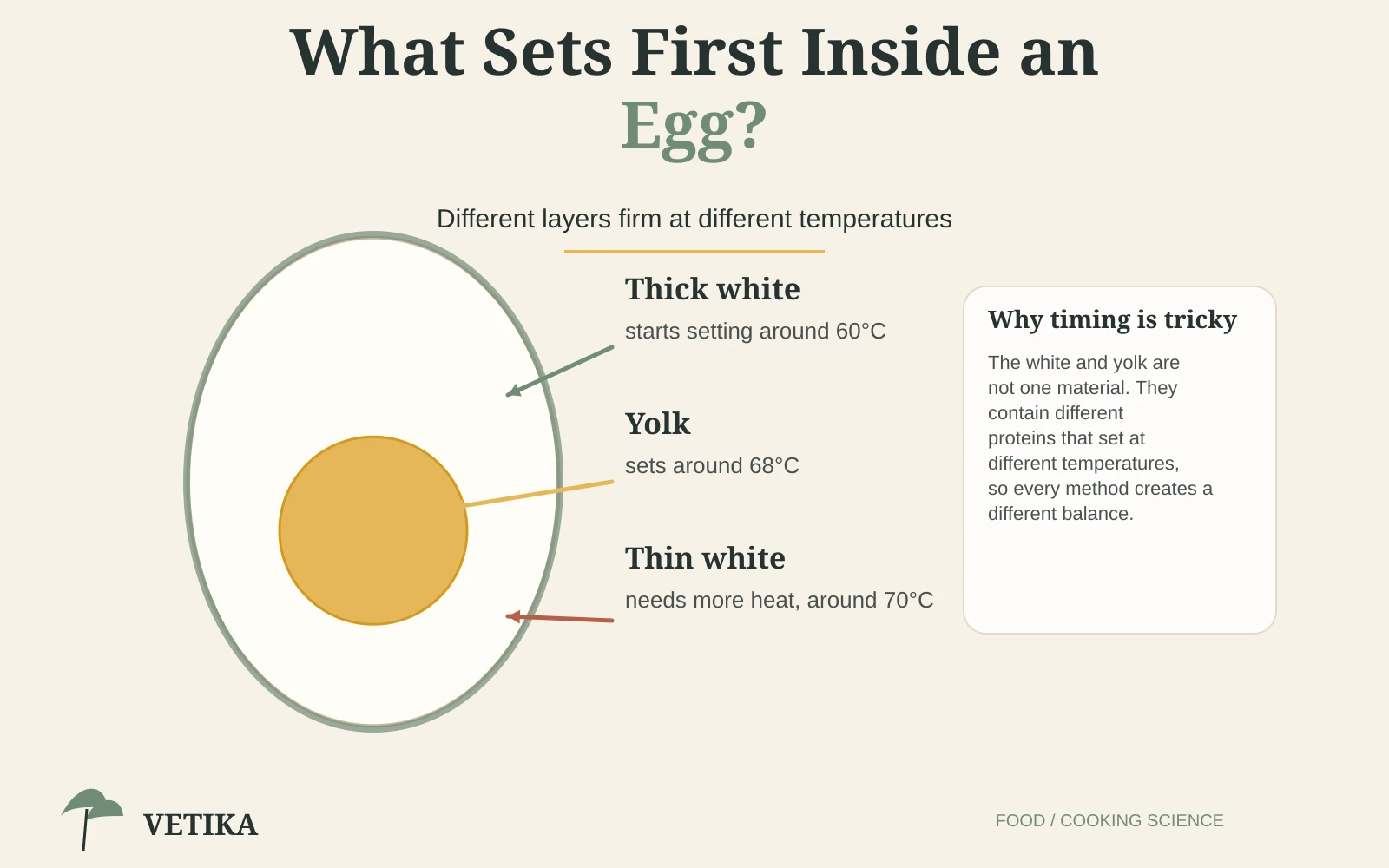
The source presents the sequence clearly:
- Thick white: begins to set around 60°C.
- Yolk: sets around 68°C.
- Thin white: sets around 70°C.
That is why no single temperature gives you every layer perfectly at once. The method you choose changes the speed and direction of heat transfer, which changes the final texture.
Method 1: boiling
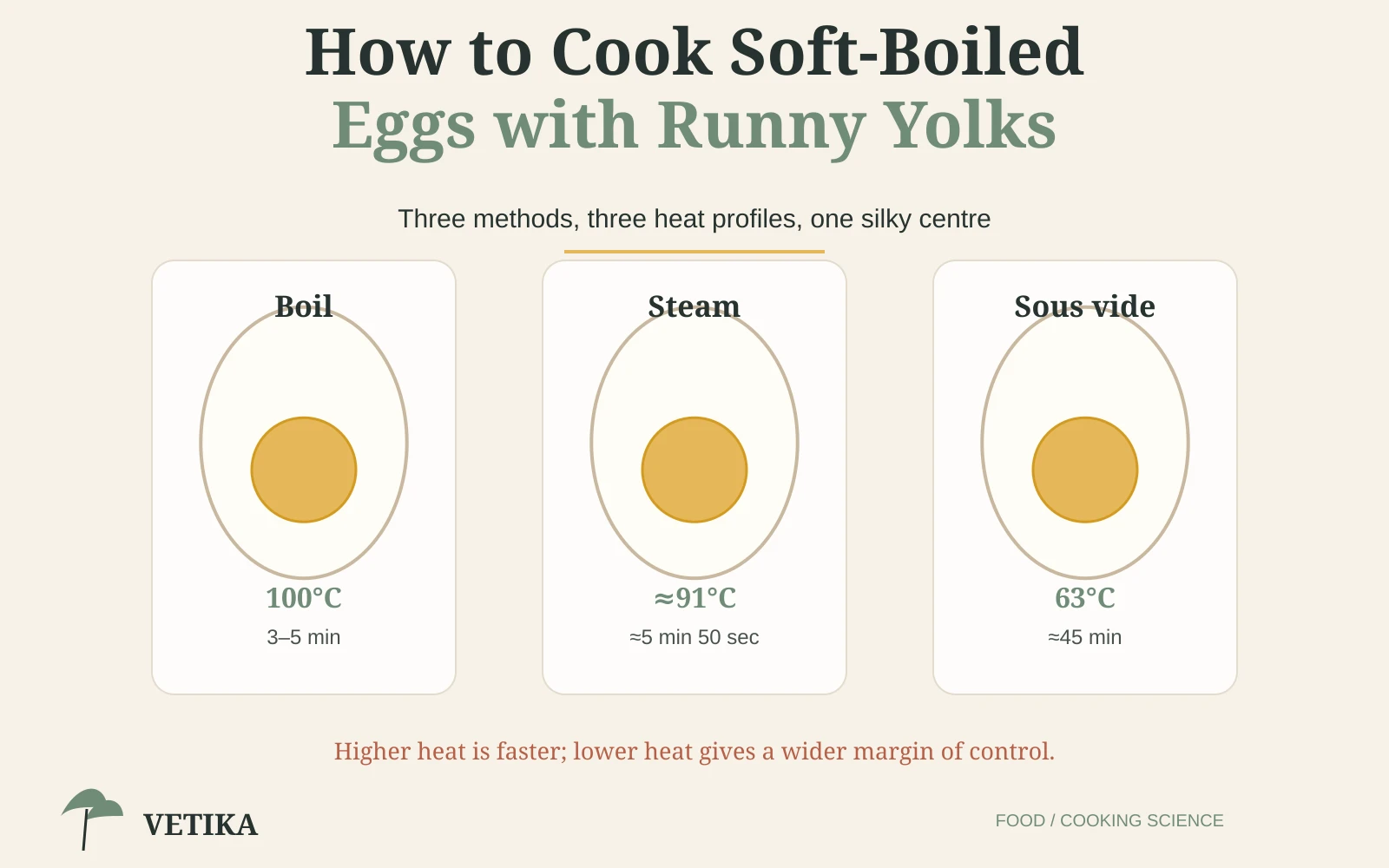
The book’s boiling method places the egg in boiling water for roughly 3–5 minutes.
The advantage is speed. The disadvantage is a narrow margin of error. Water at 100°C is far hotter than the temperatures at which the egg proteins set, so the outside changes quickly while the centre is still catching up.
That can be exactly what you want for a runny yolk—but a minute too long can move the egg much farther than expected.
Why boiling is less forgiving
The shell heats first. Then energy moves inward through the white toward the yolk. Because the water is so hot, the temperature gradient between outside and centre is large.
That gives you a set exterior and a soft interior quickly, but it also means timing matters enormously.
Method 2: steaming
The book describes steaming as a lower-temperature, more controlled alternative, using approximately 91°C for around 5 minutes 50 seconds.
Steam still transfers heat efficiently, but the overall method gives a slightly wider control window than plunging the egg directly into boiling water.
This can be useful when you want a soft centre but dislike the aggressive transition of boiling.
Method 3: sous vide
The lowest-temperature method in the source cooks the egg at around 63°C for 45 minutes.
That sounds absurdly long compared with boiling, but it illustrates the central principle beautifully: when the cooking medium is close to the final temperature you want, it becomes much harder to overshoot.
The trade-off is texture. At 63°C, the thick white can set while the thin white remains relatively loose. The book explicitly notes that the thin white can stay watery, so this method produces a different egg rather than simply a “better” version of boiling.
Which method is best?
There is no universal winner because each method produces a different heat profile.
- Boiling: fastest, most familiar, smallest margin for timing errors.
- Steaming: controlled and practical, with good white setting.
- Sous vide: exceptionally precise yolk texture, but the thin white may remain loose.
The best method is the one that gives the texture you actually want.
Does egg temperature matter?
Yes. The source notes that refrigerated eggs need a little more time than eggs at room temperature because the centre starts colder. It also notes that medium eggs cook slightly faster than large eggs.
That explains why copying a time from somebody else’s kitchen can produce a different result. Egg size, starting temperature and number of eggs all affect how quickly heat moves into the centre.
Why several eggs take longer
Every cold egg added to the pan pulls heat from the water. Add several eggs at once and the water temperature drops more than it would for a single egg.
The practical result is simple: a time that works for one egg may undercook a batch unless you adjust.
How to stop carryover cooking
The source recommends a brief cold-water treatment after cooking. That rapidly cools the outside and reduces the amount of heat continuing toward the yolk.
This is especially useful when you are chasing a very precise soft centre.
Why peeling can be frustrating
The book also discusses peeling hard-cooked eggs and explains that thin membranes sit between the shell and white. During cooking and cooling, those membranes can cling to the white. Rapid chilling helps firm the proteins and encourages the cooked white to pull away from the shell.
For very soft eggs, however, peeling may not be the goal at all. Serving them in the shell avoids damaging a delicate white that has only just set.
A more useful way to time eggs
Instead of memorising one sacred number, think in variables:
- How big is the egg?
- How cold is it?
- How hot is the cooking medium?
- How many eggs are you adding?
- How runny do you want the yolk?
That way, “four minutes” becomes a starting point rather than a guarantee.
Kitchen takeaways
A soft-boiled egg is a heat-transfer problem hidden inside breakfast.
The proteins do not all set together, so your method determines the balance. High heat gives speed and contrast between white and yolk. Lower heat gives control but creates different textures. Cooling stops the process from drifting after you have reached the point you want.
Once you understand the different setting temperatures inside the egg, soft-boiling becomes far easier to reason about—and far easier to repeat.
FAQs
Why is the yolk runny when the white is set?
Because the thick white begins setting at a lower temperature than the yolk. That gives you a window in which the white can firm while the centre remains fluid.
Is steaming better than boiling for soft eggs?
It can be more controllable, but it is not inherently better. The methods create different heat profiles and slightly different textures.
Why do refrigerated eggs take longer?
Their centres start colder, so more energy and time are needed to reach the same internal temperature.
Why does sous vide leave some egg white loose?
At the book’s 63°C setting, the thick white can firm while the thin white—whose proteins need more heat—may remain watery.
Should you cool a soft-boiled egg after cooking?
Brief cooling can reduce carryover cooking and help preserve the texture you were aiming for.