
How to Poach an Egg Perfectly: Fresh Eggs, Gentle Heat and the Science of a Compact White
Fresh eggs, gentle water and careful timing make poaching far more reliable. Learn why eggs spread, what vinegar does and how to get a neat poached egg.
There is a special kind of confidence in a good poached egg. The white looks neat rather than ragged, the centre gives gently under the spoon, and the yolk spills out in a thick golden stream instead of arriving already half-cooked.
The frustrating part is that poaching can look much harder than it really is. One egg forms a tidy cloud. The next sends ghostly threads of white through the pan. One sits perfectly. Another seems to disintegrate on contact with the water.
The difference is not luck. It is mostly egg freshness, water temperature and how gently the egg is handled.
The short answer
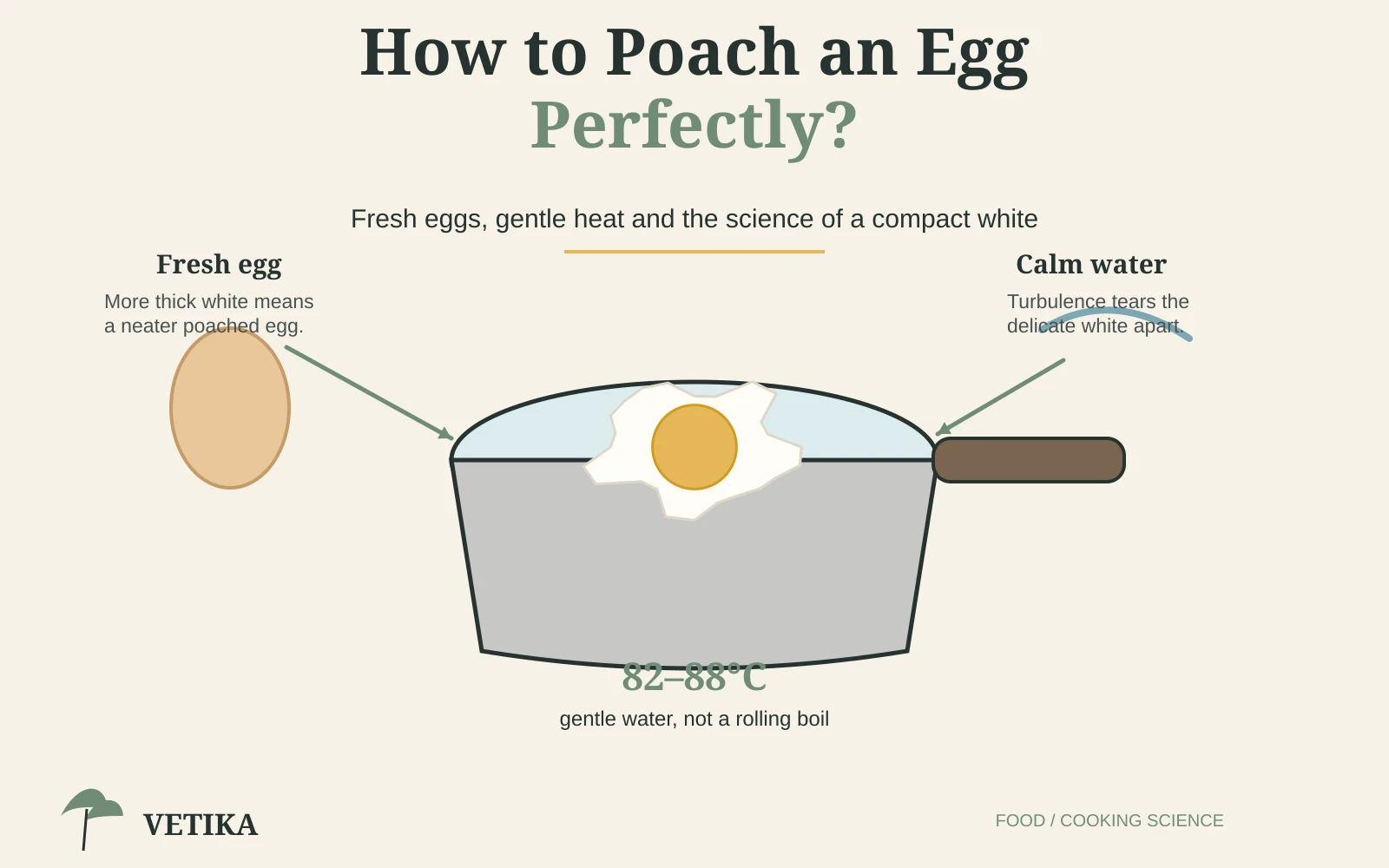
The easiest route to a neat poached egg is to use a fresh egg, keep the water just below a simmer, and lower the egg in gently. Fresh eggs contain more thick albumen, so the white clings close to the yolk instead of spreading into the pan. Gentle water lets that structure set without being torn apart by turbulence.
The book’s method adds a small amount of vinegar and salt to the water, uses a temperature of roughly 82–88°C / 180–190°F, and cooks the egg for around 3–4 minutes. The science behind those instructions is more useful than memorising them.
Why fresh eggs poach better
A fresh egg does not contain one perfectly uniform white. It contains thicker and thinner regions of albumen. As an egg ages, more of the thick white becomes loose and watery. That is exactly the material that creates the long wisps and ragged edges people associate with a “failed” poached egg.
With a very fresh egg, the thick white stays closer to the yolk. Drop it into hot water and the outside begins to set before it has had time to wander far. The result is naturally more compact.
This is the same ageing process explored in How Can You Tell if an Egg Is Fresh? The two articles belong together: one explains how freshness changes an egg, the other shows why those changes matter in the pan.
What heat is doing to the white
Egg white is mostly water plus proteins. Those proteins begin in compact, folded shapes. Heat gives them enough energy to unfold and start linking with one another. As that network forms, the clear liquid white becomes opaque and firm.
The useful trick in poaching is to let that network form without violently moving the egg around.
A rolling boil works against you. Bubbles and currents pull at the delicate white while it is still fragile. The outside can become rough before the inside has set. A quiet pan at a gentle poaching temperature gives the proteins time to connect around the yolk.
Why 82–88°C is such a useful range
The book recommends water just below a simmer, around 82–88°C. That is hot enough for the white to coagulate efficiently, but calmer than a full boil.
This is a good example of a broader cooking-science idea: faster is not always better. If a technique depends on preserving a delicate structure, the gentler heat can give you more control even when it adds a little time.
Do vinegar and salt really help?
In the book’s method, a little vinegar and salt are added to the poaching water. The explanation given is that both affect the proteins and help the white solidify more quickly, reducing the time it has to spread while still fluid.
The important point is not to turn the water sharply acidic or aggressively salty. You are nudging the protein behaviour, not seasoning a soup.
Should you make a whirlpool?
A small whirlpool can be useful when you are poaching one or two eggs. The circular movement helps guide the loose white around the yolk as the egg first enters the pan.
But the whirlpool is not the real secret. It cannot compensate for a very old egg, furiously boiling water or careless handling. Think of it as a finishing aid, not the foundation of the technique.
For several eggs at once, a dramatic whirlpool becomes less practical because the eggs can collide. Gentle placement matters more.
The strainer trick makes sense
The source method suggests removing the very thin white before poaching. A fine strainer or slotted spoon lets the loosest albumen drain away while keeping the thicker white and yolk together.
This does not “improve” the egg chemically. It simply removes the part most likely to turn into strings in the water.
It is a practical example of using structure to your advantage.
Poached egg: the 4-step method
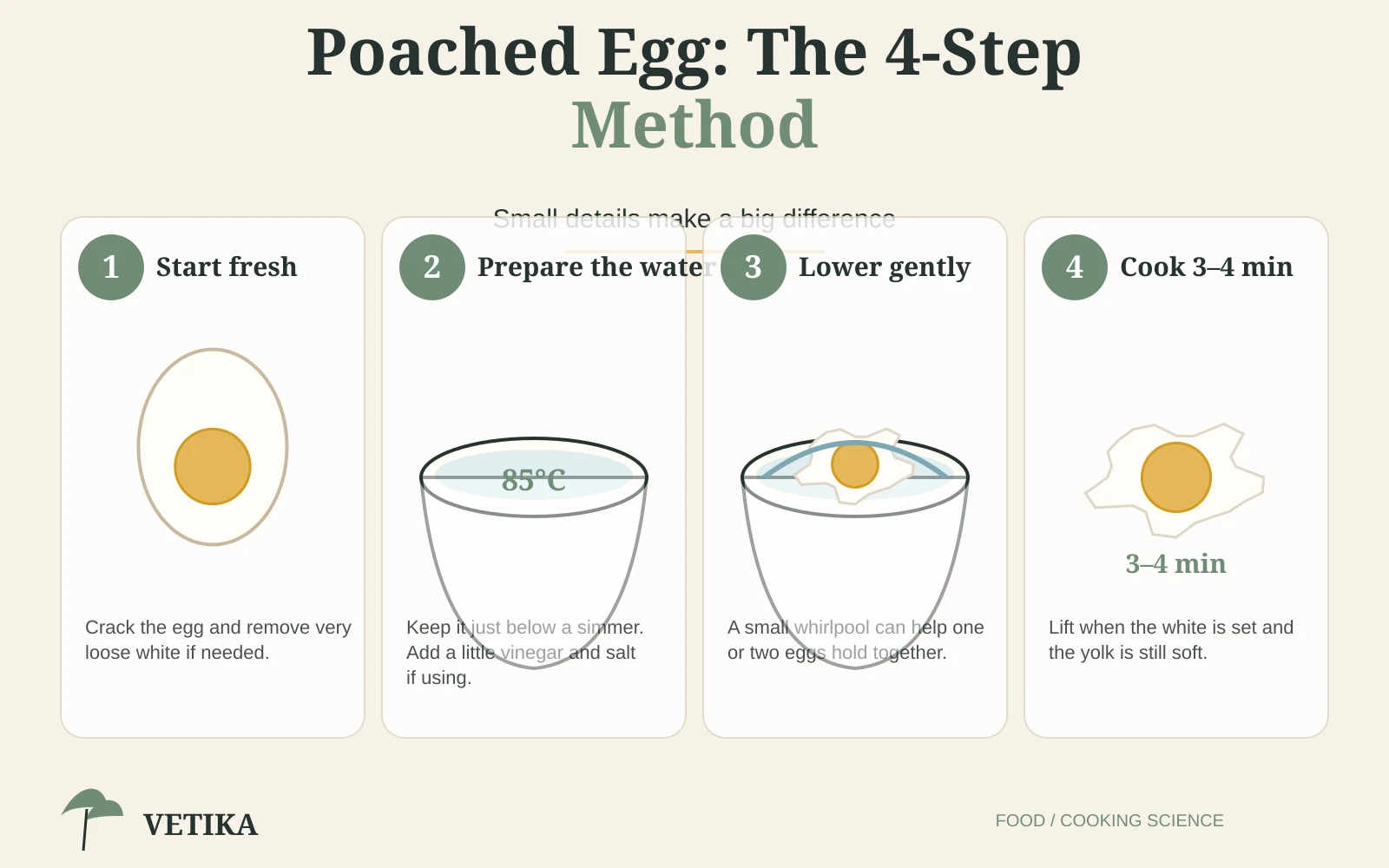
1. Start with a fresh egg
Crack the egg into a small bowl. If the white is very loose, let the thinnest portion drain briefly through a fine strainer.
2. Prepare gentle water
Heat the water to just below a simmer. The book’s target is approximately 82–88°C. If you are following its method, add a modest amount of vinegar and salt.
3. Lower the egg carefully
Bring the bowl close to the surface and let the egg slip into the water. For one or two eggs, a small whirlpool can help wrap the white around the yolk.
4. Cook for about 3–4 minutes
Watch the white rather than the clock alone. You want it set around a soft centre. Lift the egg with a slotted spoon and blot away excess water before serving.
Why poaching ahead can work
The book notes that poached eggs can be made ahead, chilled, and reheated in water. That works because once the white has formed its protein network, brief reheating can warm the egg without needing to rebuild that structure from scratch.
This is useful when cooking for several people because it separates the stressful part—forming neat eggs—from the final serving moment.
What usually goes wrong
The white spreads everywhere
The egg may be old, or you may have too much thin albumen. Use a fresher egg or drain the loosest white first.
The white looks torn
The water is probably too turbulent. Back away from a rolling boil.
The outside is rubbery while the centre is underdone
The heat is too aggressive. High heat cooks the exterior quickly but gives you less control over the centre.
The egg sticks to the bottom
Lower it gently and keep enough water in the pan that it can settle without being crushed against a hot dry surface.
The deeper lesson
A poached egg is a tiny lesson in controlled protein coagulation. The goal is not to “cook an egg in water.” The goal is to build a delicate protein network around a soft centre while disturbing it as little as possible.
Once you see the technique that way, every instruction becomes easier to remember. Freshness controls how tightly the raw white holds together. Temperature controls how calmly the proteins set. Movement controls whether the structure survives long enough to become firm.
That is why a good poached egg feels elegant: the technique is simple, but every part of it respects the ingredient.
FAQs
Do you need vinegar to poach an egg?
The book uses a small amount because acid helps the white coagulate more quickly. You can poach without it, but the method is less forgiving when the egg is not very fresh.
Why do fresh eggs make better poached eggs?
They contain more thick albumen, which stays close to the yolk instead of spreading through the pan.
Should poaching water boil?
No. A gentle temperature just below a simmer is easier on the delicate white and gives you more control.
How long does a poached egg take?
The book’s method uses roughly 3–4 minutes, but visual doneness matters more than the clock alone.
Can poached eggs be made in advance?
Yes. The source notes that they can be chilled and reheated in water, which is useful when preparing several portions.