
Why Do Some Cheeses Smell So Strong? The Microbiology of Cheese Aroma
Strong-smelling cheese gets much of its aroma from microbes breaking down proteins and fats into acids, amines, aldehydes and other volatile compounds.
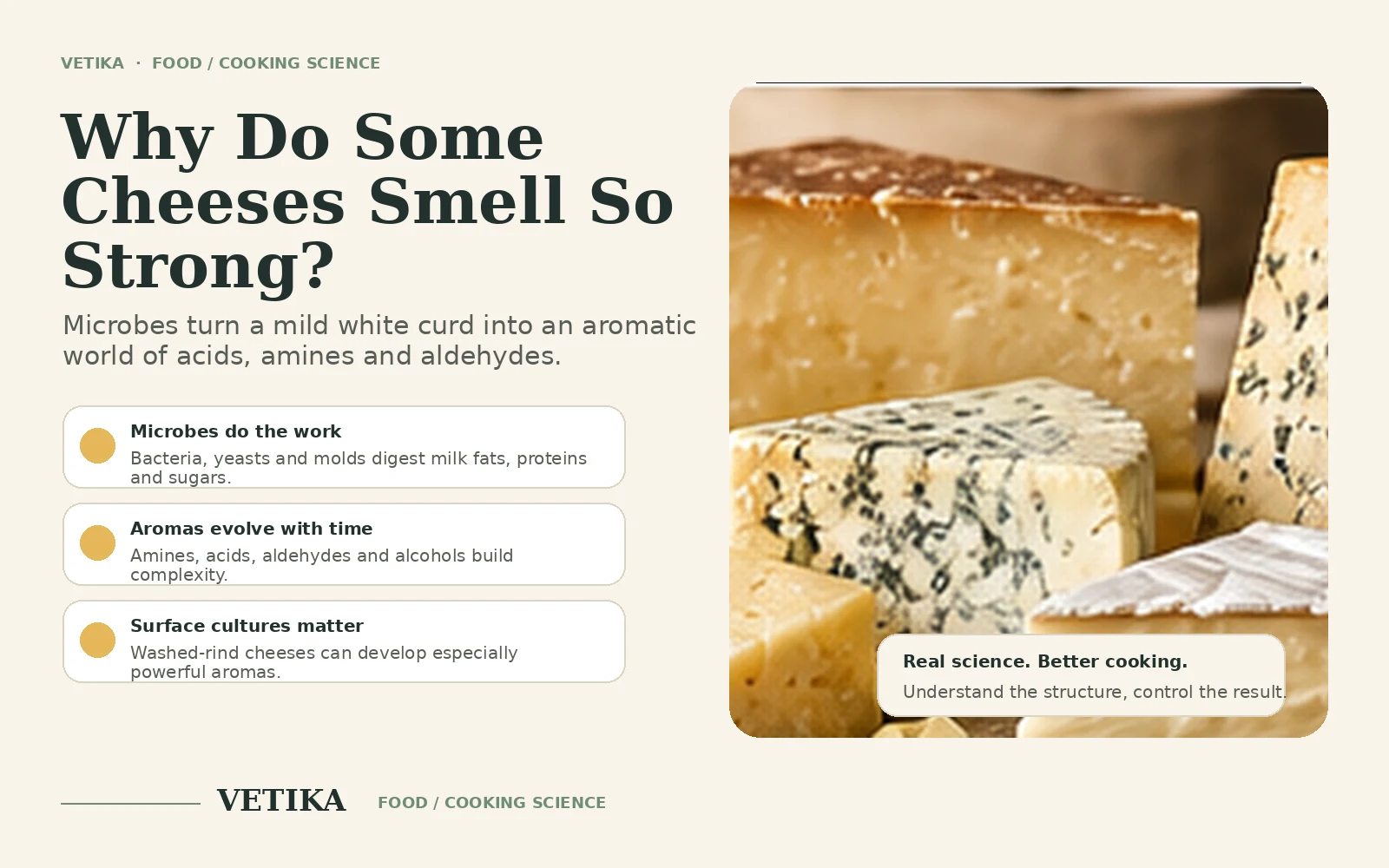
Some cheeses announce themselves before you even open the wrapper.
A wedge of mild young cheese can sit quietly on a board. A ripe washed-rind cheese can fill the entire room. The contrast feels almost absurd when both began as something as gentle as milk.
The explanation is microbial chemistry.
During ripening, bacteria, molds and yeasts do not merely sit on cheese. They eat it—slowly and selectively. As they digest milk fats, proteins and sugars, they create a growing mixture of smaller molecules. Many of those molecules are volatile, which means they escape into the air and reach your nose with extraordinary efficiency.
That is why a mature cheese can smell so much bigger than the piece sitting in front of you.
The short answer
Strong-smelling cheeses owe much of their aroma to microbes and enzymes breaking down the curd during ripening.
Proteins can be broken into amino acids, then into amines, aldehydes, alcohols and acids. Fats are transformed into their own flavour compounds. Different cultures produce different molecules, so the exact microbial community becomes part of a cheese’s identity.
The more active and distinctive that community is—and the longer it has to work—the more dramatic the aroma can become.
Cheese starts mild; ripening makes it complicated
Fresh curd is relatively simple. It tastes milky, lactic, salty and fresh. Aged cheese is chemically much busier.
The source describes ripening microbes as the real stars of the cheese world. Bacteria, fungi and yeasts digest components of milk and release compounds with their own smells and tastes.
In other words, the aroma is not sprayed onto the cheese. It is manufactured inside and on the surface of the cheese as it matures.
Protein breakdown creates a whole aroma vocabulary
Cheese proteins do not remain intact forever.
Microbes and enzymes cut them into smaller fragments, then into amino acids. Those amino acids can be transformed again into amines, aldehydes, alcohols and acids.
Some amino acids already have tastes of their own. Glutamate contributes savoury umami character. Other breakdown products can smell sharp, pungent, nutty, grassy, woody, spicy—or much stranger.
That is why “cheesy” is not one aroma. Mature cheese is a chemical orchestra.
Why cheese develops powerful aromas
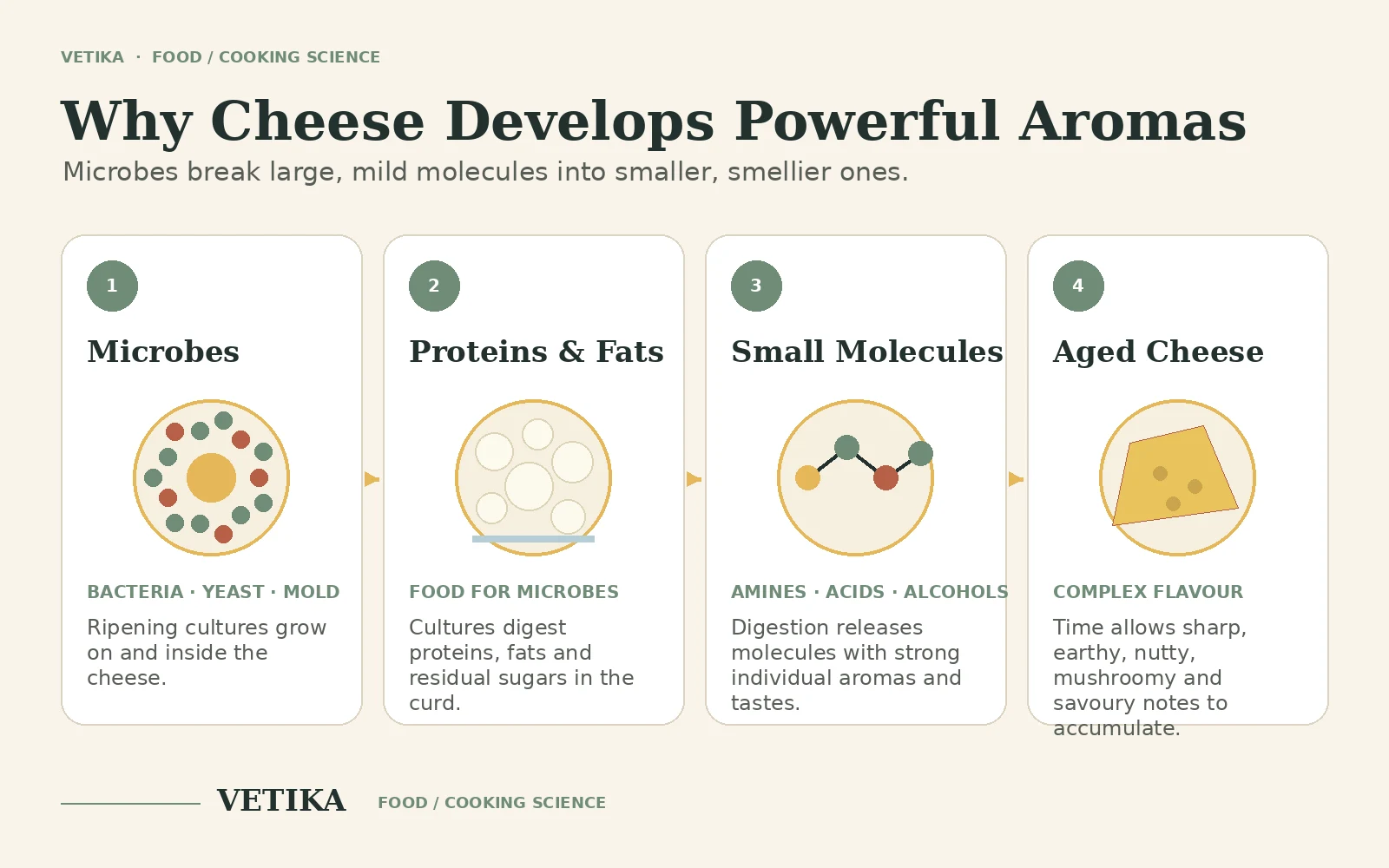
1. Microbes colonise the cheese
Starter bacteria begin the process, while other bacteria, yeasts and molds may be introduced later or encouraged on the surface.
2. They digest the curd
Proteins, fats and residual sugars become raw material for microbial metabolism and enzyme activity.
3. Smaller molecules appear
Amines, acids, aldehydes and alcohols accumulate. Many are much more aromatic than the large molecules from which they came.
4. Time builds complexity
Weeks and months give reactions time to overlap. The smell becomes not just stronger, but more layered.
Washed-rind cheeses: when bacteria take centre stage
Some of the world’s famously pungent cheeses are ripened with “smear” cultures on their surfaces.
The source calls out Brevibacterium as an important contributor to the aroma of cheeses such as Muenster and Limburger. It thrives on the moist surface conditions used during ripening and produces compounds with unmistakably powerful smells.
This is why washed-rind cheeses can smell dramatically different from a fresh goat cheese or a young mozzarella even when both are fundamentally milk proteins and fat.
The rind is an ecosystem.
Blue cheese works from the inside as well as the surface
Blue cheeses add another dimension: mold grows through channels of air within the cheese.
As those molds digest fat and protein, they generate characteristic flavour molecules. The visible blue veins are therefore not simply a colour effect. They mark zones where a specific ripening culture has been active.
That is an important distinction from accidental mold on a food that was not designed to be mold-ripened. In blue cheese, selected molds are deliberately part of the manufacturing and ripening process.
Why a rind can change the texture too
Microbes do more than create smells.
Surface organisms release enzymes that digest proteins in the curd. In very ripe soft cheeses, this can soften the area beneath the rind so dramatically that the centre remains firmer while the outside becomes almost spoonable.
A smell, a texture and a flavour can therefore share the same cause: biochemical breakdown.
Why aged cheese smells stronger when it warms up
Aroma molecules need to reach the air before your nose can detect them. Very cold food releases volatile molecules less readily.
As cheese warms, more aroma compounds escape into the space above it. That is why a cheese taken straight from the refrigerator often seems muted compared with the same cheese after it has lost some of its chill.
This does not mean leaving cheese out indefinitely; it simply explains why serving temperature changes perception.
Smell and taste are related—but not identical
A very pungent cheese can smell intimidating yet taste surprisingly balanced.
Your nose detects volatile molecules before the cheese even reaches your mouth. Once you eat it, taste receptors add saltiness, acidity, bitterness and umami, while fat and texture reshape the experience.
The smell can therefore feel more aggressive than the flavour itself.
This is another reminder that “flavour” is multisensory: aroma, taste and texture work together.
Why two cheeses made from the same milk can smell completely different
Because milk is only the starting material.
Change the microbial culture, moisture level, rind treatment, aging time, salt concentration, temperature or humidity, and you change which reactions dominate.
A cheesemaker is not simply preserving milk. They are managing an ecosystem and its chemistry.
That is why the question “what milk is this made from?” explains only part of a cheese’s character.
Kitchen takeaway
When a cheese smells intense, think ripening chemistry, not just “strong milk.”
The aroma is a record of what has happened to the curd: which microbes grew there, which proteins and fats they broke down, how much moisture remained and how long the reactions were allowed to continue.
The more you understand that process, the more a strong-smelling cheese stops being mysterious. It becomes a tiny, edible fermentation laboratory.
FAQs
Why can cheese smell stronger than it tastes?
Many aroma compounds are volatile, so they reach the nose very efficiently even when present in small amounts. Taste and smell overlap, but they are not the same sensation.
What microbes make cheese smell strong?
Different cheeses use different bacteria, yeasts and molds. The source specifically highlights Brevibacterium in powerful washed-rind cheeses such as Muenster and Limburger.
Why do aged cheeses develop more complex aromas?
Time gives microbes and enzymes longer to break fats and proteins into smaller aromatic compounds, so the chemical mixture becomes more complex.
Why does cheese smell stronger when it warms up?
Warmer cheese releases volatile aroma molecules more readily, so your nose detects them more easily than when the cheese is very cold.
Is a strong smell automatically a sign that cheese is spoiled?
No. Many cheeses are intentionally ripened with microbes that create strong aromas. However, unexpected spoilage is different from controlled ripening, so follow storage guidance for the specific cheese.