
Why Do Some Cheeses Melt Better Than Others? Moisture, Age and Protein Structure
Cheese melting depends on moisture, age, fat, acidity and the casein protein network. Learn why mozzarella stretches, cheddar can oil out and paneer stays firm.
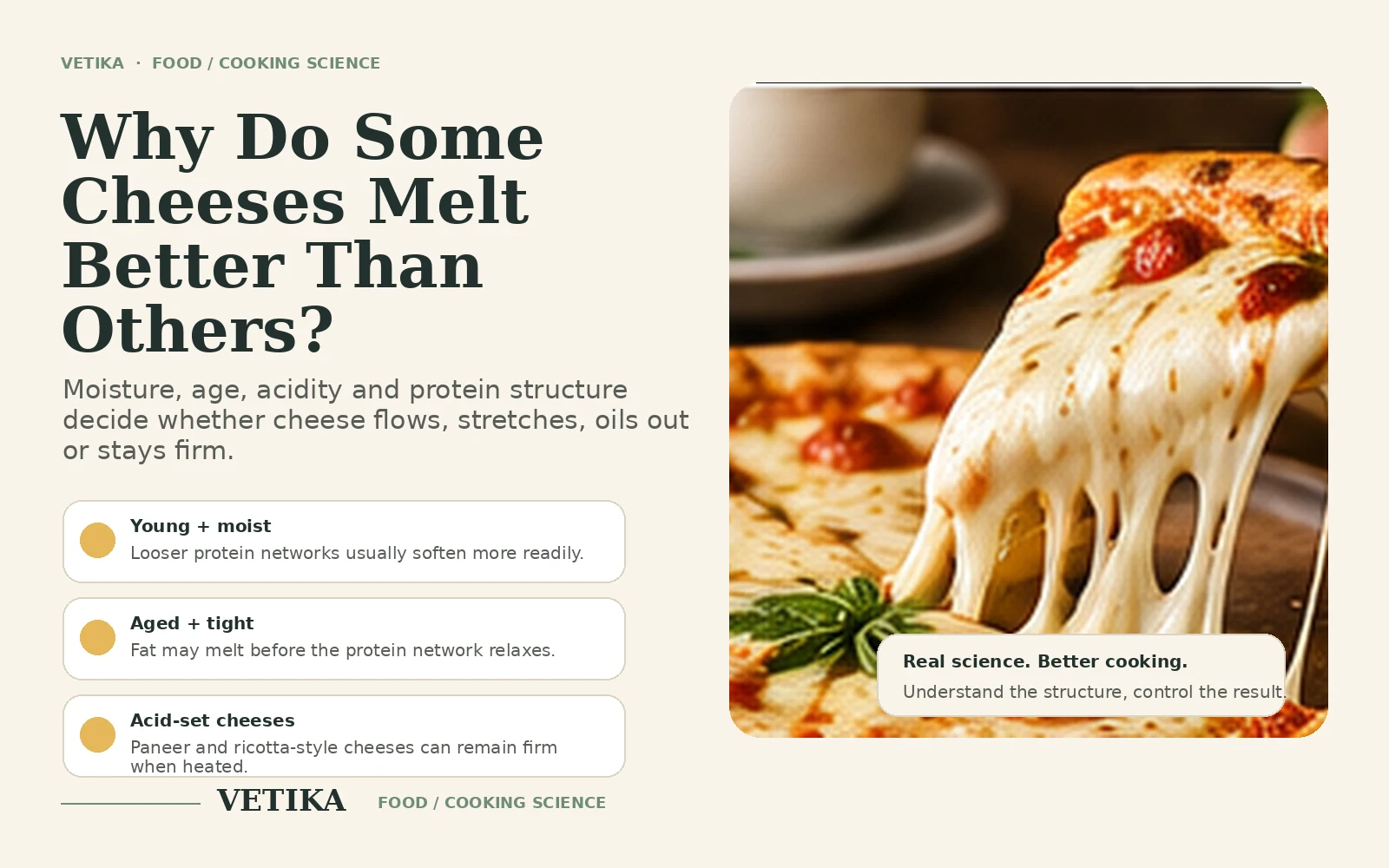
Put three cheeses into the same hot pan and you can get three completely different foods.
Mozzarella relaxes into a glossy, elastic blanket. Mature cheddar melts but may shed orange oil. Paneer can sit there defiantly, browning around the edges while keeping almost exactly the same shape.
They are all cheese. They all contain milk protein and fat. So why does heat treat them so differently?
Because cheese does not “melt” in the simple way an ice cube melts. Heat acts on a protein network filled with fat and water, and every cheese has a different version of that network.
The short answer
How well a cheese melts depends mainly on moisture, age, acidity, fat and the way its casein proteins are bonded together.
Young, moist cheeses with flexible protein networks can soften smoothly. Very mature cheeses can have tighter structures in which the fat melts before the protein network relaxes, causing oil to separate. Acid-set cheeses such as paneer or ricotta-style fresh cheese may resist melting because their proteins are locked together differently.
Melting, in other words, is a structural property.
What actually happens when cheese heats up
Cheese is a network of casein proteins containing fat, water, salt and other components.
As temperature rises, milk fat begins to liquefy. At the same time, the protein framework becomes more mobile. If the network loosens enough while still holding the components together, the cheese flows into a smooth melt.
If those events become badly out of sync, the result changes.
The fat can run out before the proteins soften. Water can escape. Proteins can tighten. Instead of a cohesive sauce, you get grease, clumps or a cheese that simply refuses to flow.
Moisture: the hidden lubricant
Young cheeses usually contain more water than long-aged cheeses.
That water helps keep proteins separated enough to move when heated. This is one reason a young mozzarella can become supple and elastic.
Dry, hard cheeses contain a denser protein matrix. They may soften, grate beautifully or add intense flavour, but they are not automatically the best choice when the goal is a smooth molten layer.
Age changes the protein network
Ripening transforms cheese proteins over time, but aging can also leave a very different balance of moisture and protein interactions.
The source notes that hard or mature cheeses such as Cheddar or Stilton can separate into greasy clumps when heated. Their fats liquefy at relatively low temperatures, while the tighter casein structure may not soften until later.
That timing mismatch matters.
Fat is ready to flow before the protein network is ready to come with it.
The result can be oiling off.
Acid can lock a cheese in place
Paneer and ricotta-style cheeses illustrate the opposite problem.
These cheeses are set with acid rather than with a rennet-dominated process. Acid makes casein proteins gather into a network that is much less willing to reorganise under ordinary cooking heat.
That is why paneer can be fried in cubes and remain recognisably cubed.
This is not a failure to melt. It is exactly the structural behaviour that makes paneer useful in dishes where you want the cheese to hold its shape.
Three very different melting behaviours
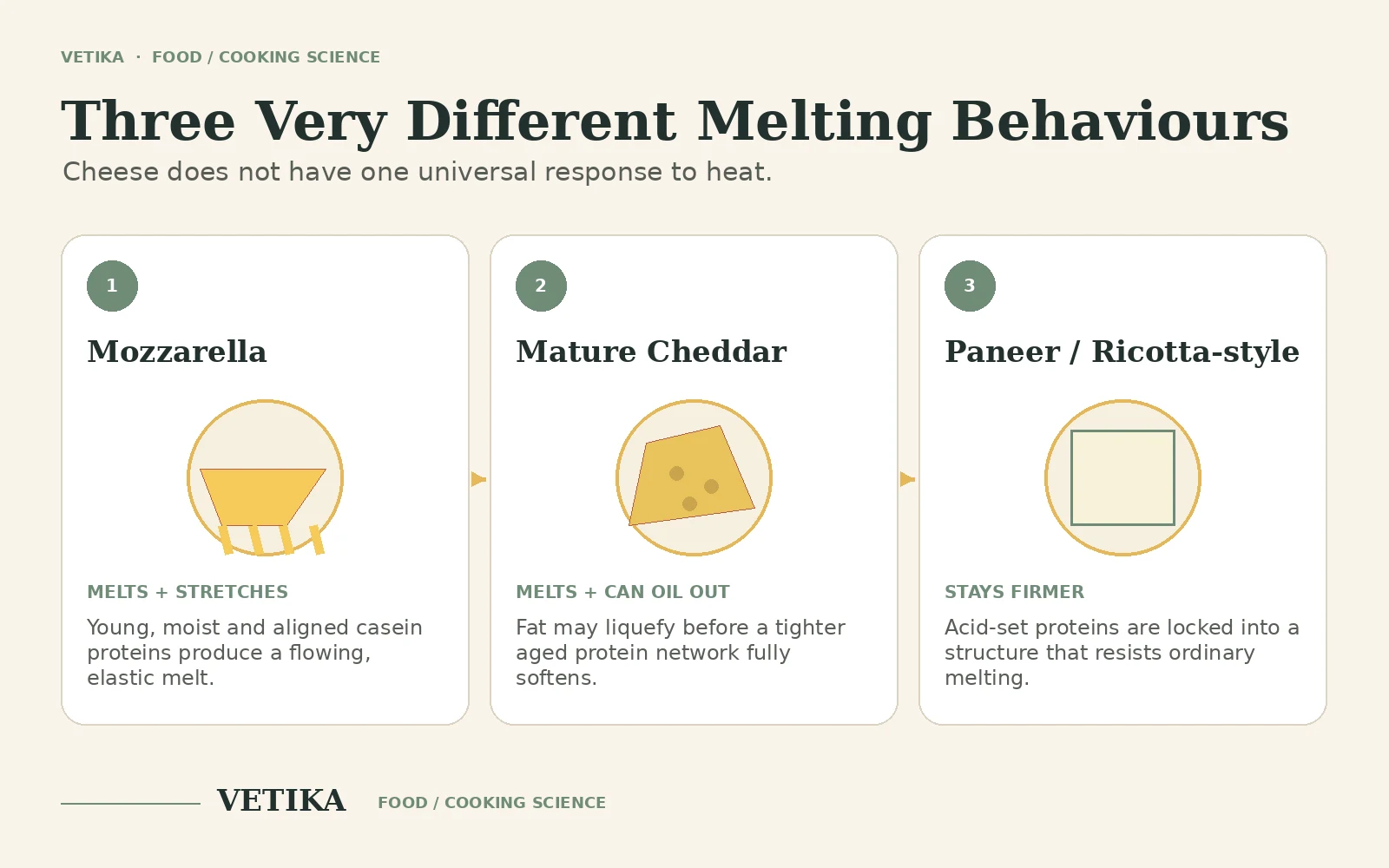
Mozzarella: melts and stretches
Young, moist and deliberately aligned proteins soften and slide while remaining connected.
Mature cheddar: melts, but may oil out
Fat liquefies readily, while the more mature protein matrix may not relax at the same rate.
Paneer or ricotta-style fresh cheese: stays firmer
Acid-set proteins form a structure that strongly resists flow.
No one behaviour is universally “better.” The right cheese depends on the job.
Why mozzarella is such a pizza specialist
Mozzarella has several useful features at once.
It is relatively moist, its casein network is flexible, and the pasta filata process aligns the proteins. When heated, it can flow while still forming long strands.
This is why our separate guide Why Does Mozzarella Stretch? deserves its own article. Stretch is a special case of melting, not the same thing.
What processed cheese changes
Processed cheese is engineered for consistency.
The source explains that emulsifying salts such as phosphates alter casein interactions, including their relationship with calcium. This makes the protein network easier to disperse and helps fat and water remain together during heating.
That is why processed cheese can create an almost unnaturally smooth, uniform melt on a burger.
It is not simply “cheap cheese melting better.” It is a cheese system deliberately reformulated to control the emulsion under heat.
Why cheese sauces sometimes turn greasy
A cheese sauce is a balancing act.
If cheese is heated too aggressively, fat can separate from the protein-water phase. High heat is especially risky with older, harder cheeses. A sauce that looked smooth can suddenly become oily and grainy.
A gentler temperature, sufficient liquid and a well-designed base make it easier to keep the system cohesive.
The lesson echoes our article on mayonnaise: fat and water can coexist beautifully, but only while the structure holding them together remains stable.
Which cheese should you choose for which job?
If you want stretch, choose a young pasta-filata cheese such as mozzarella.
If you want smooth melt with strong flavour, use a cheese that melts reasonably well and control the heat carefully, often combining it with a more melt-friendly cheese.
If you want browning without collapse, an acid-set cheese such as paneer is useful.
If you want intense seasoning, a hard aged cheese may be more valuable grated over the dish than melted into a thick layer.
Choosing cheese becomes easier when you stop asking “is this a good cheese?” and start asking “is this the right structure for this technique?”
Kitchen takeaway
Cheese melting is not about fat alone.
A good melt requires the fat, water and protein network to change together in the right way. Moisture creates mobility. Age changes the network. Acid can lock proteins in place. Processing can deliberately alter how fat and water behave.
Once you see cheese as a protein structure instead of a solid block, the pan suddenly makes much more sense.
FAQs
Why does mozzarella melt so well?
It is young, moist and has a relatively flexible, aligned casein network. Heat melts the fat and lets the protein structure move without immediately breaking apart.
Why can aged cheddar become greasy when heated?
Its fat can liquefy before the tighter aged protein network relaxes fully, so oil can separate from the cheese.
Why does paneer not melt?
Paneer is acid-set. Acid locks casein proteins into a firm structure that resists the kind of softening and flow seen in rennet-set melting cheeses.
Does higher fat automatically mean better melting?
No. Fat matters, but moisture, acidity, age and protein bonding are equally important. Melting is a structural property, not just a fat percentage.
Why does processed cheese melt so smoothly?
Emulsifying salts and processing alter casein interactions and help keep water and fat together as the cheese heats, producing a very uniform melt.