
Why Does Mozzarella Stretch? The Protein Science Behind the Perfect Cheese Pull
Mozzarella stretches because its casein proteins are aligned during pasta filata processing, then soften and slide when heated while remaining connected.
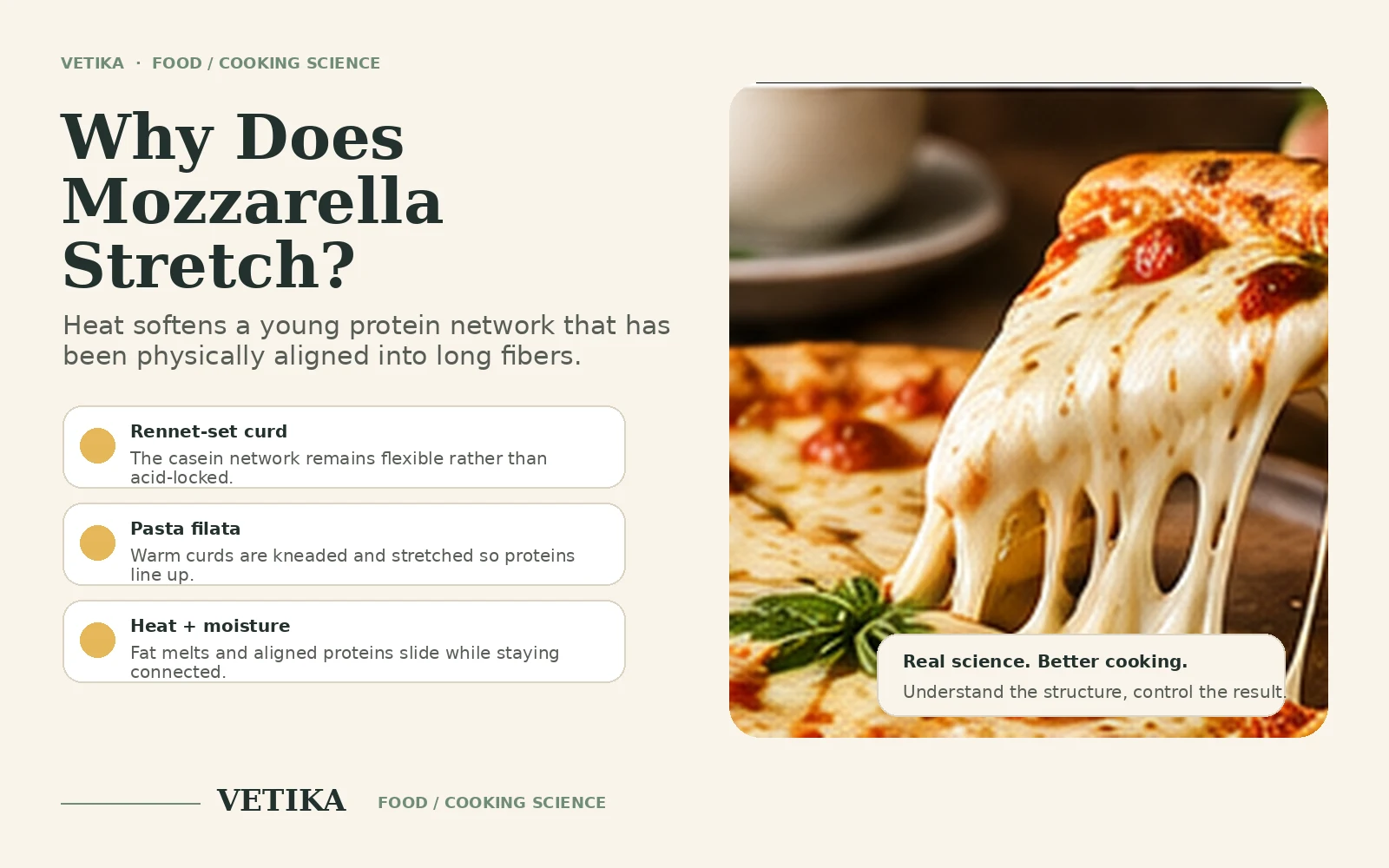
There is a reason food advertising loves a cheese pull.
A fork lifts a slice of pizza, the crust rises—and the mozzarella refuses to let go. Instead of snapping immediately, it stretches into long glossy threads that can extend absurd distances before finally breaking.
That stretch is not just “melted cheese.” It is the visible result of how mozzarella’s proteins were organised before the pizza ever went into the oven.
Mozzarella is made by a stretched-curd process called pasta filata. Warm curds are kneaded and pulled so their casein proteins line up into long fibers. When the cheese is heated again, fat melts and the protein network becomes mobile. Because those proteins are aligned rather than randomly locked together, they can slide and extend while staying connected.
That is the cheese pull.
The short answer
Mozzarella stretches because it has a young, moist, flexible casein network that has been physically aligned during cheesemaking.
The curd is first formed with bacteria and rennet. It is then warmed and kneaded. That stretching step lines up the proteins in the same general direction.
Later, when mozzarella is heated on pizza or in a sandwich, the fat liquefies and the protein network softens. The aligned proteins can slide past one another without instantly separating, producing long elastic strands.
Stretch begins during cheesemaking
It is tempting to think the oven creates mozzarella’s stringiness. The oven only reveals it.
The important structural work happens earlier.
Mozzarella belongs to the pasta filata family—literally “stretched paste” or stretched curd. During production, the curd is warmed until it becomes pliable, then kneaded and stretched rather like dough.
That physical treatment rearranges the casein network.
Instead of a random tangle, the proteins become more oriented. The finished cheese contains layers and fibers that are primed to elongate later.
Why rennet matters
Mozzarella is not set simply by dumping acid into milk.
The source explains that mozzarella is made with bacteria and rennet, producing a curd in which the casein proteins can retain enough flexibility to align into fibers.
This differs from an acid-set cheese such as paneer or ricotta-style fresh cheese. Acid can cause casein proteins to knot together in a much less reversible way. Those cheeses may soften or brown, but they do not reorganise into the same long, stretchy threads.
So mozzarella’s behaviour is connected directly to how the milk was curdled.
Why mozzarella pulls into strings
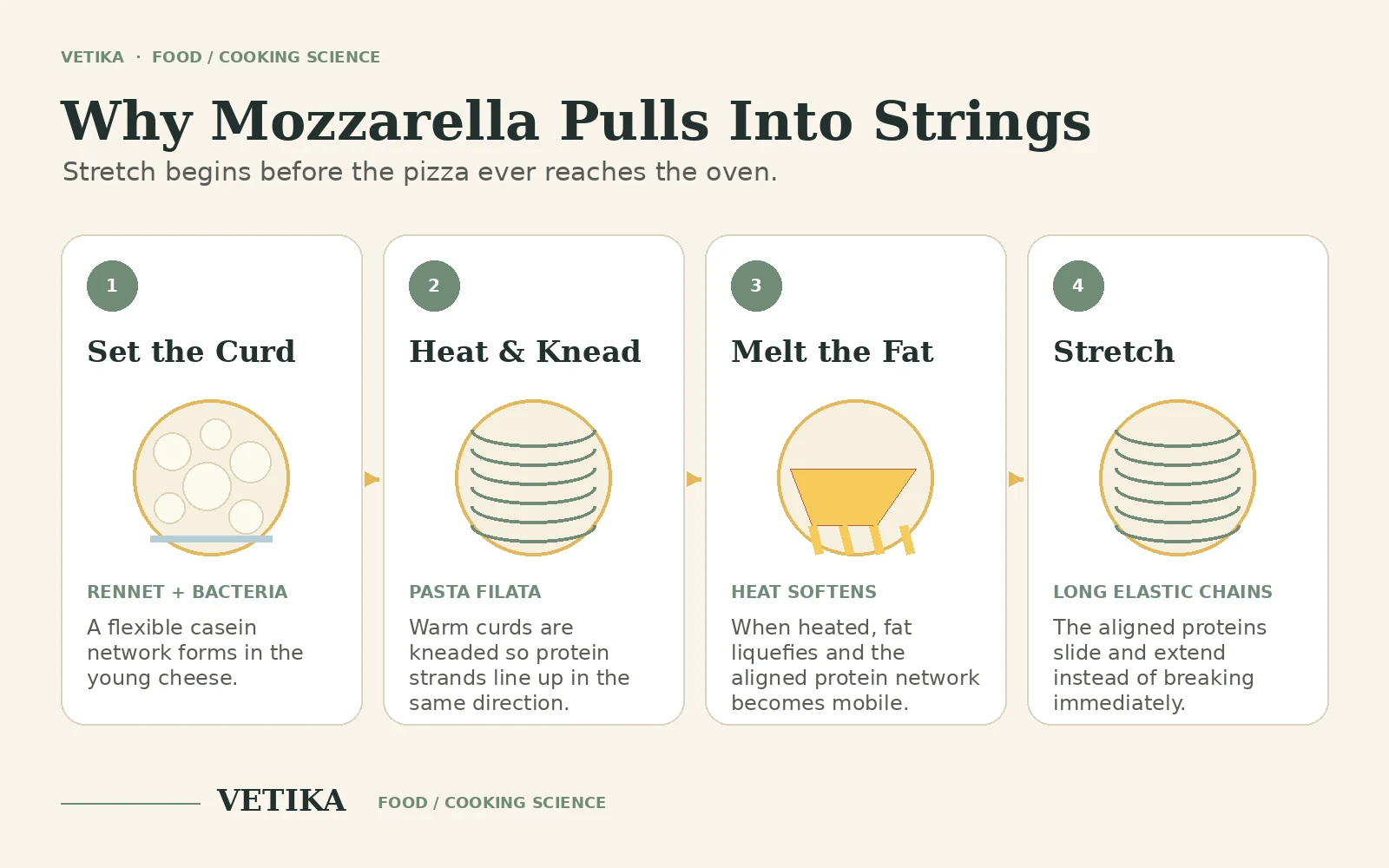
1. A flexible curd forms
Bacteria and rennet create a young casein network with enough mobility for later stretching.
2. The curd is heated and kneaded
Warm curd becomes pliable. Repeated pulling lines the proteins up into fibers.
3. Heat melts the fat
On pizza, the cheese warms again. Fat liquefies and the protein network loosens.
4. Aligned proteins slide
Because the proteins are oriented, they move in long connected chains instead of simply fragmenting.
The visual stretch on your fork is therefore a macroscopic version of what the proteins are doing microscopically.
Why moisture matters
A stretchy cheese needs enough water for the protein network to remain mobile.
A very dry cheese has a denser, more rigid structure. A young, moist mozzarella gives the proteins more freedom to move when heated.
That does not mean “more water is always better.” Very wet fresh mozzarella can release noticeable moisture onto a pizza. Low-moisture mozzarella behaves differently because it has been drained more thoroughly.
The ideal choice depends on the result you want.
What fat contributes
Fat does not create the stretch by itself, but it changes how the protein network moves and how the melted cheese feels.
As the cheese heats, fat liquefies. This lubricates the network and contributes richness, while the casein framework provides the actual elastic continuity.
Think of melted mozzarella as a partnership: fat flows; proteins hold the bridge together.
Why cheddar can melt without giving the same pull
Cheddar has a different history.
It is typically older, its protein network has been modified by aging, and its structure is not deliberately aligned in the pasta filata way. It can melt beautifully, but the melt may be shorter, oilier or less elastic.
This is why “melts” and “stretches” are not synonyms.
A cheese can melt without giving you the cinematic pizza pull.
Why paneer stays solid
Paneer is a useful opposite example.
It is acid-set. The proteins are pulled into a firm network that resists ordinary melting. Put cubes of paneer in a hot pan and they can brown while keeping their shape.
That contrast makes mozzarella much easier to understand:
- mozzarella: flexible, aligned, rennet-influenced network;
- paneer: acid-set, more locked network.
The chemistry of curd formation becomes the behaviour you see in the pan.
Can mozzarella become too hot?
Yes. Stretch has a useful window.
With enough heat, the cheese can lose moisture, fat can separate and the protein network can eventually become less pleasant. That is why mozzarella at its best looks glossy and elastic rather than dry, greasy or rubbery.
The goal is not simply “maximum temperature.” It is enough heat to mobilise the network without wrecking it.
Why this matters for pizza
Pizza gives mozzarella an almost perfect stage.
The oven supplies enough heat to melt fat and soften proteins. The cheese remains anchored to the sauce and crust. When you pull the slice away, the network is forced to extend.
A cheese chosen only for flavour may not perform the same way. Pizza cheese is partly an engineering problem: you want flavour, browning, moisture control and the right kind of protein elasticity.
Kitchen takeaway
Mozzarella stretches because cheesemakers build stretch into it.
The curd is formed in a way that stays flexible, then physically stretched so the casein proteins align. Heating later turns that invisible alignment into visible strings.
The next time a pizza produces an outrageous cheese pull, you are not just seeing melted dairy. You are seeing the memory of the cheesemaking process.
FAQs
Why does mozzarella stretch instead of simply melting?
Its curd is heated and kneaded during pasta filata processing, aligning casein proteins into long fibers. When reheated, the network becomes mobile but remains connected, so it stretches.
What does pasta filata mean?
It is the stretched-curd technique used for mozzarella: warm curds are kneaded and pulled so the protein structure becomes aligned.
Why does ricotta not stretch like mozzarella?
Ricotta-style and other acid-set cheeses have a different, more tightly locked protein structure that does not form the same long elastic network.
Does moisture affect mozzarella stretch?
Yes. Stretch depends on a balance of moisture, fat and protein structure. A young, moist cheese can move more freely when heated.
Why does mozzarella sometimes release water on pizza?
High-moisture mozzarella contains more water, and heating can drive some of it out. Different mozzarella styles therefore behave differently on pizza.