
How Does Milk Become Cheese? From Casein Curds to Ripening
Milk becomes cheese when casein proteins form curds, whey is drained and microbes reshape flavour during ripening. See the whole transformation clearly.
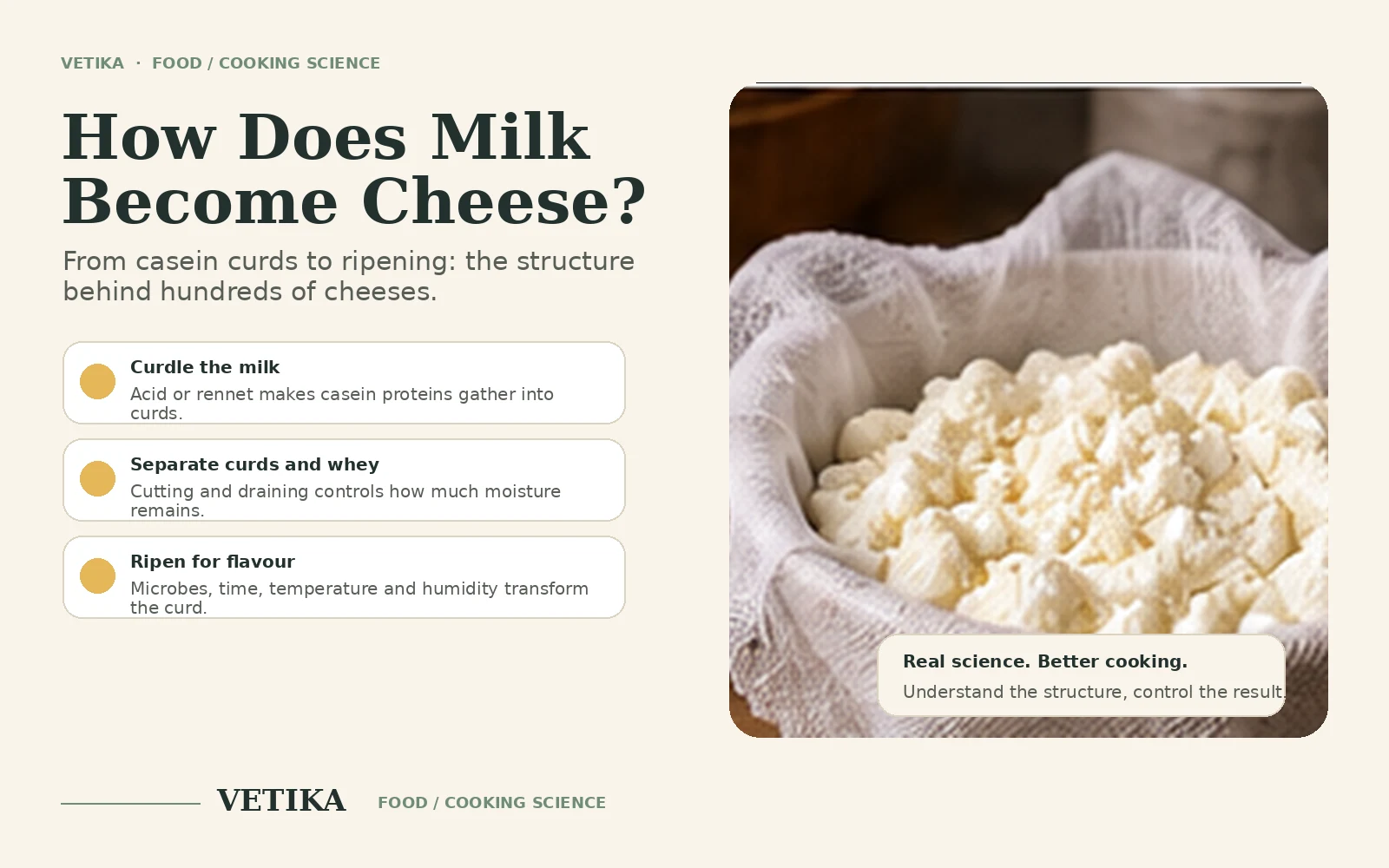
Milk and Parmesan do not look as though they belong to the same family.
One pours. The other fractures into hard, savoury shards. Milk tastes mild and fresh; a long-aged cheese can smell nutty, grassy, mushroomy, peppery or almost aggressively funky. And yet the raw material is recognisably the same.
The transformation happens because cheesemaking is, at heart, a controlled reorganisation of milk.
Proteins that once floated freely are persuaded to gather into a solid network. Water-rich whey is removed. Salt, pressure, microbes, temperature and time then keep rewriting that network until a fresh white curd becomes mozzarella, Camembert, Manchego, Parmesan—or something else entirely.
The short answer
Milk becomes cheese when its casein proteins form curds, trapping much of the milk fat with them. The remaining liquid is whey. Cheesemakers then control how much whey is removed, how the curd is cut, whether it is pressed or salted, which microbes are present and how long the cheese ripens.
Those choices determine an astonishing amount of the final result: whether the cheese is soft or hard, mild or powerful, crumbly or elastic, fresh or deeply aged.
Cheese is not simply milk with the water taken out. It is milk whose structure has been deliberately rebuilt.
Start with milk: a liquid full of hidden structure
Milk looks simple because the pieces inside it are microscopic. It contains water, milk sugar, fat, minerals and proteins. For cheesemaking, the most important proteins are caseins.
In fresh milk, casein proteins remain dispersed rather than collapsing into obvious clumps. Cheesemaking begins by changing the conditions around them so that this stable arrangement no longer holds.
Once the caseins begin sticking together, they form a three-dimensional network. Fat becomes trapped within that network. The result is the curd: the material from which cheese is built.
How do you make the curd?
There are two broad routes described in the source material: acid and rennet.
Acid can make casein lose its stability
Bacteria naturally used in cheesemaking consume milk sugar and produce lactic acid. As acidity increases, casein proteins become less stable and begin gathering into curds.
Acid can also be added directly. That is the principle behind simple fresh cheeses made with lemon juice or vinegar, such as paneer-style or ricotta-style preparations.
Rennet works differently
Rennet contains enzymes that act on casein and allow the proteins to cluster in a more organised way. This is a crucial distinction because the way the curd forms later affects how the cheese behaves when heated.
A rennet-set young cheese such as mozzarella can develop a flexible protein network. An acid-set cheese such as paneer tends to remain much more solid during cooking.
That means the future behaviour of a cheese begins surprisingly early—at the moment the milk is first turned into curd.
Curds and whey: one pot, two very different futures
When curdling succeeds, the milk separates visibly.
The curds are the solid clusters rich in casein and fat. The whey is the watery liquid left around them.
From here, cheesemaking becomes a game of moisture control.
Cut the curd into larger pieces and less whey escapes quickly, helping produce a softer, moister cheese. Cut it more finely and far more surface area is exposed, making it easier for whey to drain away. Hard cheeses can therefore begin with much smaller curd pieces than very soft cheeses.
This is one of the most useful ideas in the entire cheese chapter: texture is heavily influenced by how much whey remains in the curd.
From milk to cheese: four decisions
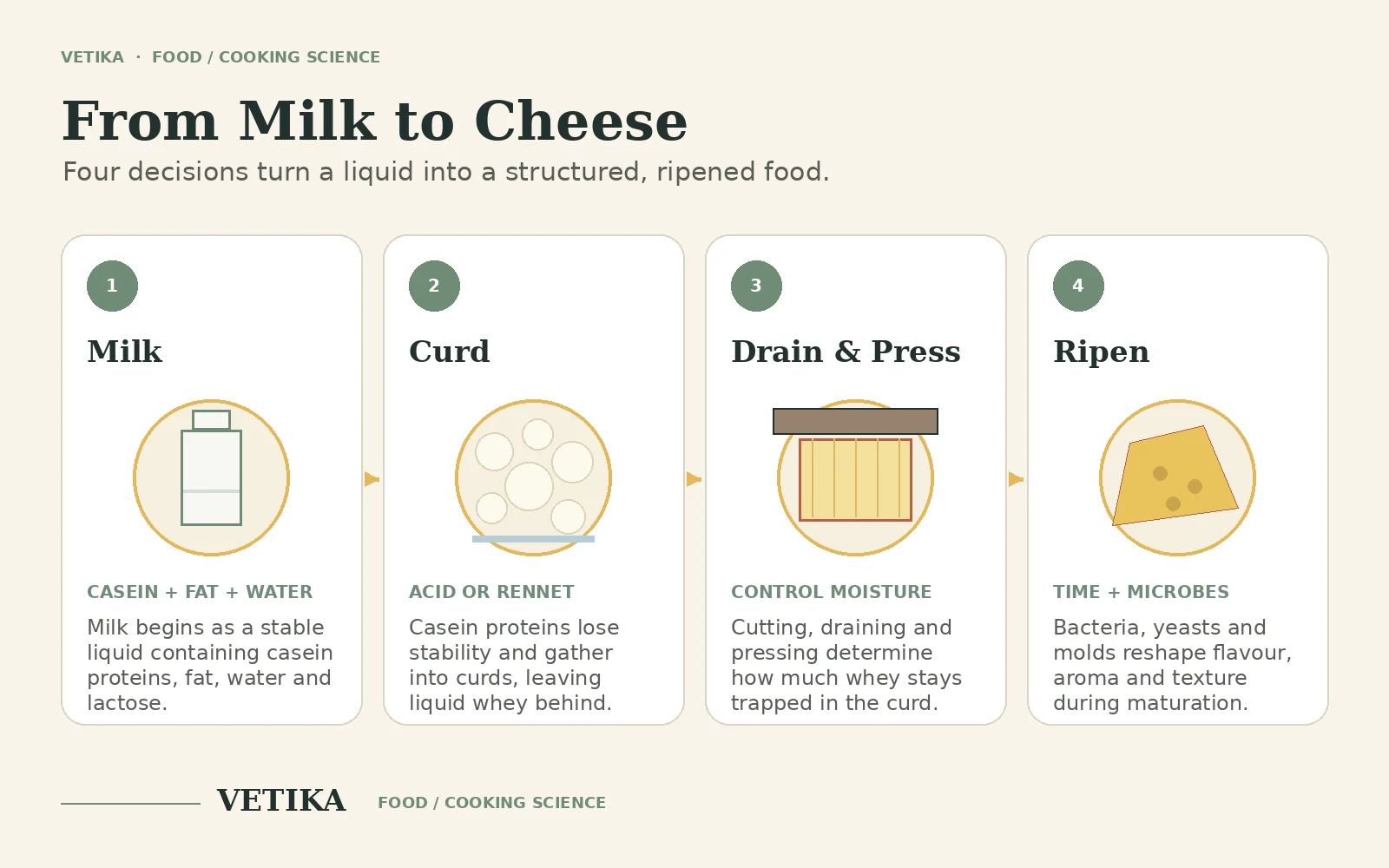
1. Destabilise the milk proteins
Acid, rennet or a combination of biological processes causes casein to gather into curds.
2. Cut and drain the curd
The curd is cut so whey can escape. The size of the pieces helps determine how much moisture remains.
3. Shape, salt or press
Some cheeses are simply drained. Others are placed into molds, weighted, pressed or treated with brine. Pressing squeezes out more whey and creates a denser structure.
4. Ripen—or eat fresh
Fresh cheeses may be ready after hours or days. Aged cheeses continue changing for weeks, months or even years.
What ripening really does
A young curd is only the beginning. During ripening, bacteria, yeasts and molds can digest parts of the cheese’s fats, proteins and sugars.
This sounds destructive, but controlled breakdown is exactly what creates complexity.
Large, relatively bland molecules are cut into smaller molecules with stronger individual tastes and aromas. Proteins can be broken into amino acids and then into other aromatic compounds. Fats are transformed into their own flavour molecules. Acids accumulate. Surface microbes can soften a rind while internal molds can create veins and pockets of flavour.
This is why time does more than simply “dry” a cheese. It changes its chemistry.
Why one cheese becomes soft and another hard
Moisture is one of the biggest variables.
A cheese that retains a great deal of whey begins with a softer, more open structure. A cheese that has been cut into tiny curds, heavily drained and pressed becomes denser.
But moisture is not acting alone. The final texture also depends on:
- the type of milk;
- whether acid or rennet set the curd;
- the microbes used;
- salt;
- pressing;
- age;
- ripening temperature and humidity.
That is how one ingredient—milk—can generate thousands of recognisably different cheeses.
Why cheese flavour is so much more intense than milk
Milk begins relatively mild. Cheesemaking concentrates it physically, then ripening amplifies it chemically.
Removing whey concentrates the fat and protein-rich curd. Ripening then breaks parts of that concentrated material into increasingly aromatic compounds.
This is why a tiny shaving of a hard aged cheese can transform a whole bowl of pasta. You are tasting a food that has been concentrated and then chemically developed over time.
The rind is not just packaging
In many aged cheeses, the rind is biologically active. Surface molds, bacteria or yeasts can live there, releasing enzymes that migrate into the cheese and change the texture immediately beneath the surface.
That helps explain why a very ripe soft cheese can be firmer in the centre and almost liquid near the rind.
The outside is participating in the ripening process.
Why this matters in the kitchen
Understanding how cheese is built makes it easier to predict how it will cook.
A young, moist, rennet-set cheese can soften and stretch dramatically. A dry, old cheese may grate beautifully but can separate into oil if heated too aggressively. An acid-set cheese may brown in a pan while stubbornly refusing to melt.
The useful question is no longer simply “what cheese do I like?” It becomes:
What structure does this cheese have, and what will heat do to that structure?
That question leads naturally to our guides on why mozzarella stretches and why some cheeses melt better than others.
Kitchen takeaway
Cheesemaking is controlled separation followed by controlled transformation.
First, milk proteins are gathered into curds. Then cheesemakers decide how much whey to remove. After that, salt, pressure, microbes and time shape the result.
Once you see those stages, the cheese counter looks different. A soft cheese and a hard cheese are no longer unrelated products. They are different answers to the same set of structural decisions.
FAQs
What actually makes milk turn into cheese?
Cheese begins when casein proteins lose their normal stability and gather into curds. The liquid whey is then removed to different degrees, and many cheeses are pressed, salted and ripened.
What is the difference between curds and whey?
Curds are the protein-and-fat-rich clusters that become cheese. Whey is the liquid left behind after those curds separate from the milk.
Why are hard cheeses drier than soft cheeses?
They retain less whey. Smaller curd pieces, more draining and pressing remove more moisture and create a denser final cheese.
Why does cheese need to ripen?
Ripening gives microbes and enzymes time to transform proteins, fats and sugars into smaller molecules that change aroma, flavour and texture.
Does every cheese use the same microbes?
No. The choice of starter bacteria, surface cultures, molds and yeasts is one of the major reasons different cheeses develop different personalities.