
How to Make Fresh Cheese at Home: The Science of Acid-Set Curds
Make a simple ricotta-style fresh cheese by warming milk, adding acid and draining the curds. Learn exactly why the milk separates and how draining changes texture.

There is a wonderfully dramatic moment in fresh cheesemaking when milk stops looking like milk.
One minute the saucepan holds a smooth white liquid. Add acid, wait, and suddenly the surface looks broken. Soft white islands gather together while a thinner, yellowish liquid appears around them.
To someone making cheese for the first time, it can look as though the milk has gone wrong.
It has done exactly what you wanted.
Those white clusters are curds. The liquid is whey. And the transformation is one of the clearest demonstrations of milk-protein chemistry you can perform in an ordinary kitchen.
The short answer
You can make a simple fresh, ricotta-style cheese by warming whole milk, adding an acid such as lemon juice or white-wine vinegar, allowing casein proteins to form curds, then draining away the whey.
The source method heats 1 litre of milk to 74–90°C / 165–194°F, removes it from the heat, adds salt and acid, then rests the mixture for 10–15 minutes. The curds are lifted out and drained in muslin. A short drain gives a soft cheese; a long drain gives a drier, more crumbly one.
The recipe is simple because the chemistry is doing most of the work.
Before you start: a sensible milk choice
For a home kitchen, VETIKA recommends using pasteurised whole milk and clean equipment. This is a practical safety addition to the source method rather than a claim taken from the book.
Whole milk gives you enough fat for a pleasant, creamy result. The technique is designed to teach acid-set curd formation rather than long-term fermentation or aging.
This is best thought of as a fresh ricotta-style acid-set cheese, not a long-ripened cheese and not traditional whey ricotta.
What acid does to milk proteins
Milk’s casein proteins normally remain dispersed. They do not simply fall to the bottom of the bottle because their microscopic structure keeps them apart.
Acid changes that environment.
As acidity rises, the casein proteins lose stability, move closer together and begin forming clusters. Those clusters trap some fat and grow into visible curds.
The watery phase left behind is whey.
That is why lemon juice or vinegar can turn a saucepan of milk into something you can lift with a spoon.
Why the milk is heated first
The source warms the milk before acid is added.
Heating makes the system more responsive and helps the curds form cleanly. You are not trying to boil the milk violently. You are creating the right conditions for separation.
The source range—74–90°C—is deliberately broad enough for a simple home method rather than a precision aged-cheese process.
Fresh cheese in three steps
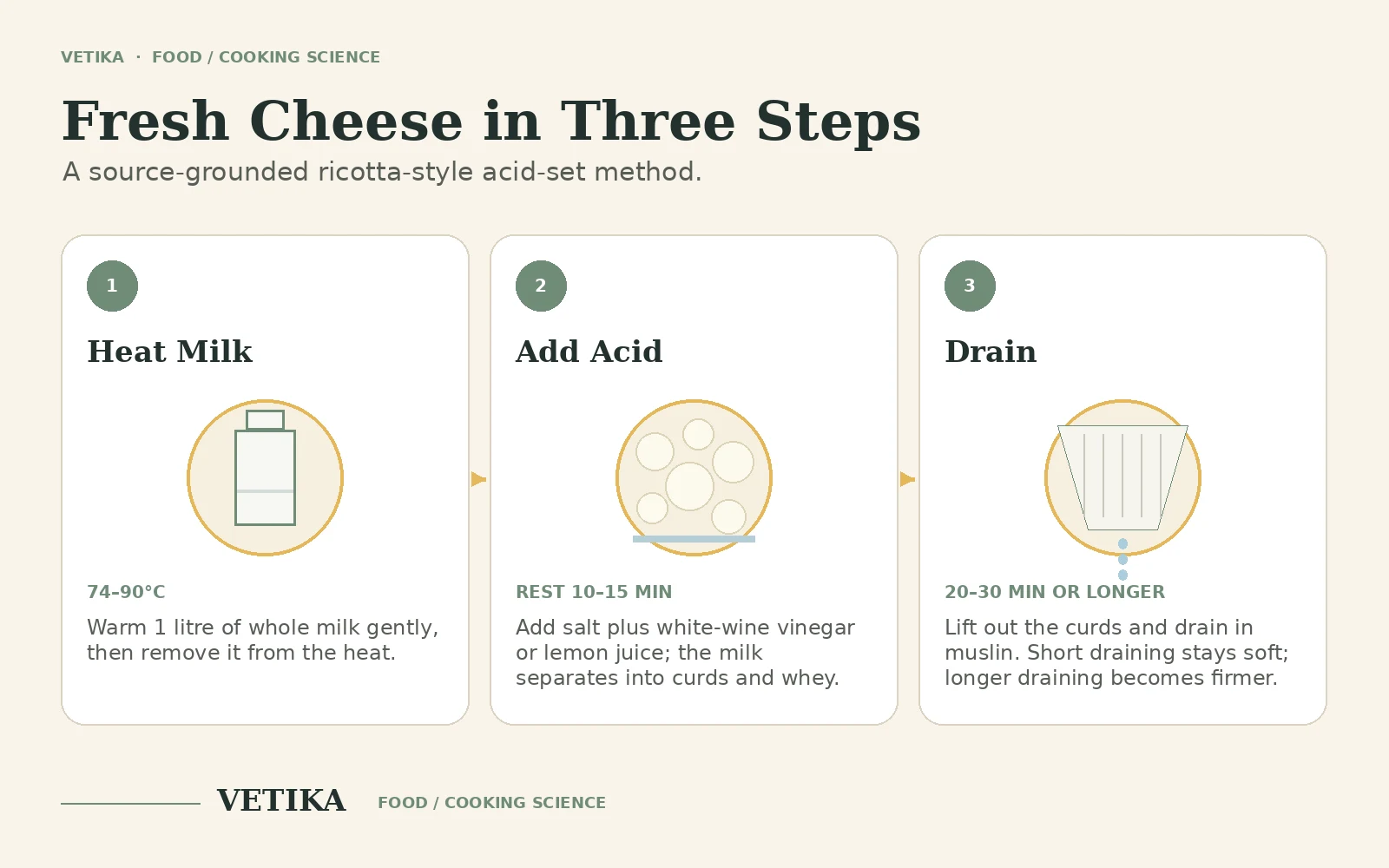
1. Heat the milk
Pour 1 litre of whole milk into a saucepan and warm it gently to 74–90°C / 165–194°F.
Remove the pan from the heat.
2. Add salt and acid
The source method adds 1½ teaspoons of salt plus either 2 tablespoons of white-wine vinegar or the juice of 1 lemon.
Stir, then leave the mixture for 10–15 minutes as the curds separate from the whey.
3. Drain the curds
Lift the solid curds from the whey with a slotted spoon and place them into muslin or a suitable cheesecloth.
Drain for 20–30 minutes for a very soft texture. Leave them substantially longer—up to overnight in the source method—for a drier, more crumbly cheese.
Draining is a texture control
The chemistry creates the curd. Draining decides what the curd feels like.
A short draining time leaves more whey trapped between the proteins, so the cheese remains soft, moist and spoonable.
A longer drain removes more water. The same curd becomes firmer and more crumbly.
This is the same larger principle we see across cheesemaking: moisture is one of the master controls of texture.
Why this cheese does not melt like mozzarella
The answer is already inside the recipe.
You used acid to set the proteins.
Acid-set casein proteins form a structure that does not loosen under heat in the same way as mozzarella’s rennet-set, stretched network. The fresh cheese can warm, soften slightly or brown, but it does not produce long elastic strings.
That makes this recipe a perfect practical companion to Why Does Mozzarella Stretch? and Why Do Some Cheeses Melt Better Than Others?
You can make two very different cheeses from milk because you built two different protein structures.
What happens to the whey?
Whey is the liquid separated from the curd. It still contains water-soluble components from the milk.
The source method focuses on the curds because they are the goal of the recipe, but the separation itself is worth observing carefully. Notice how different the whey looks from the original milk: the white opacity has largely moved into the curd.
That visual change tells you how much structure has been removed from the liquid phase.
Fresh cheese versus aged cheese
Fresh cheese stops early in the cheesemaking story.
There is no long ripening stage in which molds, yeasts and bacteria develop a complex aromatic profile. That is why the flavour stays clean, milky and mild.
An aged cheese continues for weeks or months, allowing microbial and enzymatic reactions to reshape the curd.
Our guide How Does Milk Become Cheese? explains that larger journey in detail.
Storage and serving
The source says the finished cheese can be eaten immediately or refrigerated in an airtight container for up to three days.
Keep it chilled rather than attempting to age this simple home preparation. This is a fresh cheese method, not a controlled maturation process.
Fresh cheese is also a good demonstration of why temperature affects flavour perception. Very cold cheese releases aroma less readily, while a slightly less chilled serving can taste more expressive. Use sensible food-safety handling and do not leave fresh dairy sitting warm for extended periods.
How to change the result without changing the chemistry
Once you understand the basic process, you can adjust texture more confidently.
For a softer cheese, drain less.
For a firmer cheese, drain longer.
For a cleaner, brighter flavour, choose lemon. For a more neutral acid contribution, vinegar may suit you better.
These are culinary adjustments built on the same underlying event: acid destabilising casein.
Kitchen takeaway
Fresh cheese is a small recipe with a big lesson.
You begin with a stable liquid, change the conditions around its proteins, and watch a new structure appear. Then you control texture simply by deciding how much whey to remove.
That is the heart of cheesemaking in miniature.
The saucepan is not just giving you dinner. It is showing you how milk becomes a solid food.
FAQs
What makes the curds form in homemade fresh cheese?
Acid destabilises casein proteins in the warmed milk. They gather together into visible curds while the watery whey separates.
What temperature does the source method use?
The book heats 1 litre of whole milk gently to 74–90°C / 165–194°F, then removes it from the heat before adding salt and acid.
How long should fresh cheese drain?
The source suggests about 20–30 minutes for a very soft result, with longer draining—up to overnight—creating a drier, more crumbly texture.
Why does this cheese not melt like mozzarella?
It is acid-set, so its casein proteins are locked into a firmer structure rather than the flexible rennet-set network used for mozzarella.
How long does the source keep the finished cheese?
The source says to serve it immediately or refrigerate it in an airtight container for up to three days.