
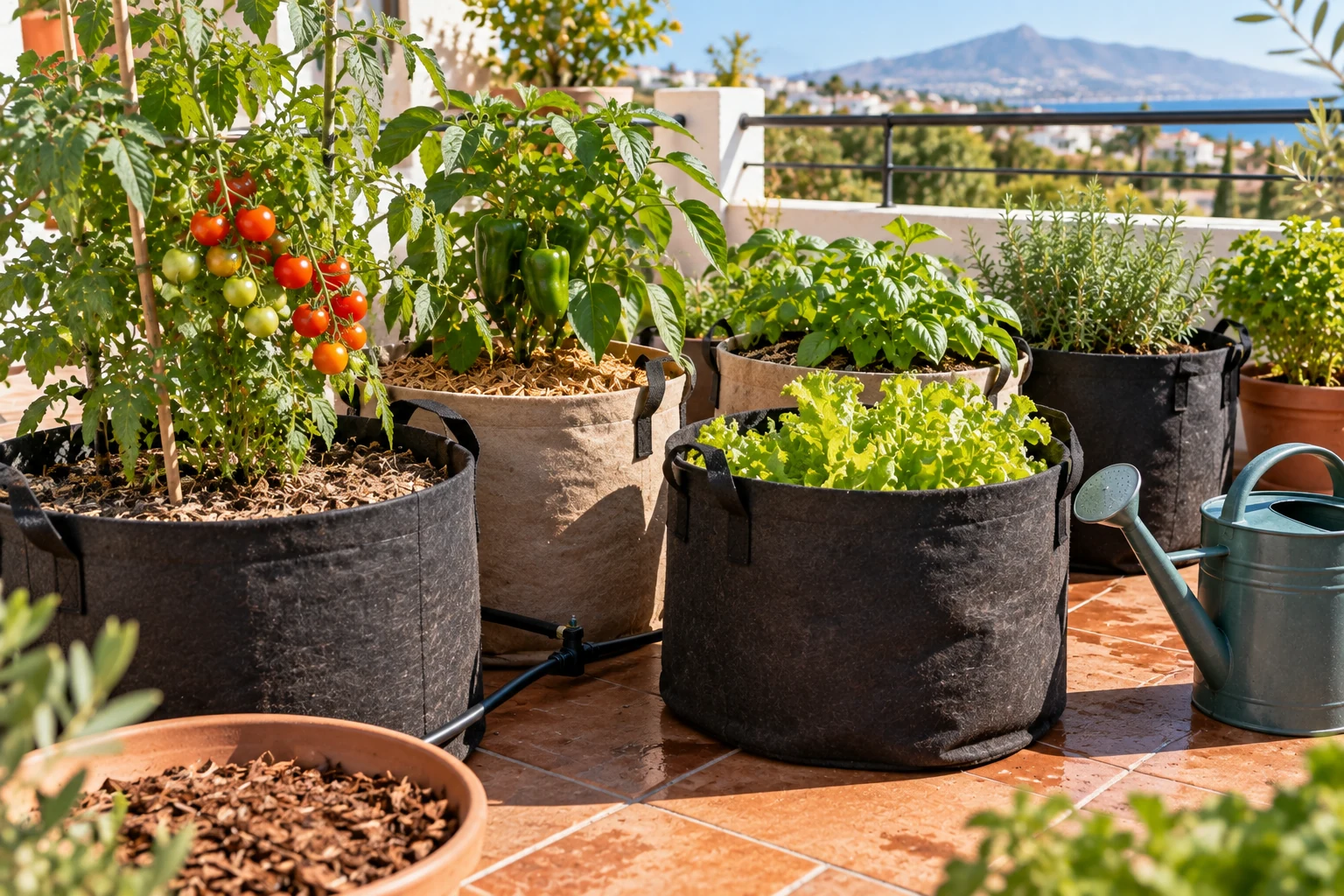
The essentials
Fabric grow bags have clear advantages: they are lightweight, portable and allow substantial air exchange around the growing medium, supporting the root response often described as *air pruning*. The same porous wall, however, can also increase water loss. If a grow bag goes from moist to very dry within hours, the answer is not necessarily to “water more.”
Useful troubleshooting separates how much water the system can store, how quickly it is losing water and how much the plant is using.
This guide checks the system in this order: volume → exposure → growing medium → plant → watering method → surface evaporation → automation.
Quick checklist
If a grow bag dries too quickly:
1. Confirm that container volume matches plant size.
2. Check hours of direct sun and wind exposure.
3. Verify that the entire growing medium becomes wet rather than only a narrow channel.
4. Water slowly enough to wet the full profile.
5. Add an appropriate surface mulch to reduce evaporation.
6. Group or shelter bags that receive strong wind.
7. Consider drip or microirrigation if repeated daily watering is becoming necessary.
8. Do not use a fixed schedule without checking actual moisture.
1. Why fabric bags can dry faster

Illinois Extension notes that porous container materials, including fabric, dry more quickly than non-porous materials. Colorado State also explains that exposed container sides increase evaporation. [S2][S5]
A rigid plastic pot limits most exchange to the surface and drainage openings. A fabric bag exposes much more of its perimeter directly to moving air.
That does not make fabric a poor material. It means its irrigation management is different.
2. Measure what “drying fast” actually means
The phrase can describe several different patterns:
- only the top centimetres are dry;
- the top third is dry;
- the entire profile is dry;
- the plant wilts while lower medium remains moist;
- water exits rapidly without uniformly wetting the bag.
Run a simple observation:
1. water thoroughly;
2. record the time and conditions;
3. check moisture near the surface and deeper in the bag;
4. repeat after 4, 8, 12 and 24 hours when practical;
5. note sun, shade and wind.
The goal is to identify a pattern rather than discover a universal number of hours.
3. Volume often matters more than the bag material
A small bag has little stored water. As the plant grows, the ratio between foliage and medium volume may become unfavourable.
University of Maryland recommends matching container size to plant size. Oregon State and Penn State likewise treat container sizing as a basic requirement for productive vegetable container growing. [S1][S6][S7]
Signs the grow bag is undersized
- watering is needed several times per day even after uniform wetting;
- roots occupy much of the available volume;
- the plant is tall, productive or carries substantial foliage;
- water use increased sharply later in the season;
- the bag becomes light only hours after watering.
Changing irrigation time may reduce symptoms, but greater volume usually increases the underlying water reserve more directly.
4. Sun, heat and dark fabric
Warmer growing medium loses water faster, while a warm plant may also transpire more rapidly.
Illinois Extension warns that dark containers in intense summer sun can become hot and cause growing media to dry quickly. [S4]
A black fabric grow bag can combine two processes:
- evaporation through the wall;
- heating from solar radiation.
What to test
Before replacing the bag:
- position it so the fabric receives less direct sun during the hottest period;
- shade the **container** without necessarily shading the whole crop;
- group bags so less side wall is fully exposed;
- reduce direct contact with exceptionally hot paving when practical.
Do not seal the entire fabric wall in plastic without understanding the consequences for drainage and aeration.
5. Wind can amplify the problem
Wind continually replaces humid air next to the fabric wall and the leaves, favouring water loss.
Illinois Extension recognises wind as an important container-site factor and notes that it can desiccate plant tissues. In hot, dry and windy conditions, container moisture may need very frequent checking. [S4][S8]
Progressive solutions
1. move bags near a wall or railing that reduces wind without eliminating airflow;
2. group containers;
3. use a permeable wind screen in very exposed locations;
4. protect large leaves from constant strong gusts.
A fully solid barrier can create turbulence. Aim for partial protection rather than an enclosed chamber.
6. The growing medium may store too little water
A highly coarse mix can drain and aerate very well but provide too little water reserve for an exposed grow bag.
This does not mean replacing it with heavy garden soil. University sources favour container media that balance water retention and aeration. [S1][S6]
Review:
- coarse-particle fraction;
- stable organic matter;
- peat or coir content;
- compaction;
- age of the mix;
- how easily it accepts water after drying.
VETIKA A03 covers growing-medium selection in detail.
7. Excessively dry mix can become difficult to re-wet
Illinois Extension notes that some soilless mixes shrink when allowed to dry excessively, leaving gaps around the container wall. [S2]
In a grow bag, that can produce a frustrating sequence:
1. water is applied;
2. some drains quickly;
3. the bag appears watered;
4. the centre remains dry.
Re-wet more effectively
- apply water slowly;
- divide irrigation into several passes;
- wait a few minutes between passes;
- check the centre of the profile;
- continue until moisture is reasonably uniform.
Drainage from the bottom alone does not prove that the entire root zone is wet.
8. Wet the whole surface, not only the stem area
One application point may work in a small pot. In a wide grow bag, a single dripper can create a local wet column while other areas remain dry.
This is particularly relevant for:
- large tomatoes;
- potatoes;
- several plants sharing one bag;
- wide bags;
- very porous media.
Check moisture at several points.
VETIKA A06 explains how to measure emitter discharge, while T01 uses measured flow to calculate scheduled irrigation volume.
9. How much water should I apply?
There is no universal litre-per-bag value.
The amount depends on:
- medium volume;
- starting moisture;
- crop;
- plant size;
- weather;
- medium properties;
- drainage;
- growth stage.
A more reliable approach is learning how much water your container requires to move from its normal pre-irrigation state to a uniformly moist profile without keeping it continuously saturated.
Practical test
1. measure water applied;
2. distribute it slowly;
3. wait 20-30 minutes;
4. check several locations;
5. record the amount.
Repeat under different conditions. A local range is more useful than a generic figure.
10. Mulch can reduce evaporation
University of Maryland specifically shows straw mulch used over a fabric grow bag to reduce evaporation and help maintain more even medium temperatures. [S1]
Possible materials include clean straw, suitable shredded dry leaves and other compatible organic mulches.
Keep mulch away from the main stem when continuous stem moisture could create problems.
What mulch cannot do
Mulch primarily reduces evaporation from the top surface. It does not eliminate water loss through the fabric wall, so it can help substantially without making a fabric bag behave like plastic.
11. Should I use a saucer underneath?
A saucer can capture drainage, but it should not automatically be used to keep the bottom of the grow bag permanently submerged.
Roots require oxygen, and continuously saturated conditions can create a different set of problems.
If a saucer is used:
- use it to observe drainage or protect flooring;
- do not assume it should remain full;
- follow crop and product guidance;
- avoid prolonged standing water.
12. Grouping grow bags can help
An isolated bag exposes its entire side wall. In a group, some sides are protected from direct sun and wind.
Grouping may:
- reduce lateral exposure;
- partially stabilise the microclimate;
- simplify a shared drip line;
- make side shading easier.
Maintain enough spacing for foliage airflow.
13. When automation becomes worthwhile
If a bag requires irrigation every second day, automation may be optional. If summer conditions require daily or repeated checking, drip irrigation can improve consistency.
Do not simply program “10 minutes every morning.” First establish:
- emitter flow;
- number of emitters;
- distribution;
- duration;
- number of irrigation events.
The VETIKA irrigation planner converts those inputs into scheduled water volume.
14. One dripper or several?
The answer depends on bag diameter and lateral water movement in the medium.
One dripper
May be adequate in small bags or media that spread water well.
Multiple application points
May improve uniformity in large bags.
Do not add emitters without recalculating total delivery. Two identical emitters operating simultaneously approximately double sector flow.
15. Split irrigation can sometimes improve wetting
When medium is extremely dry, one large application can move through channels before redistributing.
Compare:
Programme A: all water in one event.
Programme B: the same total volume divided into two events.
Then measure moisture at several depths.
There is no guarantee that split irrigation is always superior; it is a diagnostic test for infiltration and distribution in your specific medium.
16. Plant demand changes through the season
A grow bag that stayed moist for two days in spring can require much closer attention after a mature tomato fills the container with roots and foliage.
Do not freeze the same irrigation schedule for the entire season.
Reassess after:
- heat waves;
- rapid canopy growth;
- flowering and fruiting;
- major pruning;
- relocation;
- several weeks of root expansion.
17. Wilting does not always mean the bag is dry
Wilting may result from:
- drought;
- heat;
- root problems;
- overwatering;
- wind injury;
- disease.
Before adding more irrigation, feel or measure the medium at depth.
A bag that looks dry on the outside may still hold substantial moisture inside.
18. Fabric versus plastic: a useful comparison
| Feature | Fabric grow bag | Non-porous plastic pot |
|---|---|---|
| Side-wall evaporation | Higher | Lower |
| Side-wall aeration | Higher | Lower |
| Weight | Low | Low-medium |
| Rapid-drying risk | Higher under exposed conditions | Usually lower |
| Air pruning | Characteristic benefit | Much less pronounced |
| Need for close irrigation monitoring | High in hot/windy climates | Depends on size and crop |
This table does not declare a winner. The correct container depends on climate, crop, management and water availability.
19. Troubleshooting by pattern

It dried rapidly from day one
Inspect volume, exposure and medium.
It started drying rapidly only after the crop grew
Inspect plant-to-volume ratio and root density.
It dries rapidly only on windy days
Prioritise shelter and grouping.
Water exits immediately while the centre stays dry
Prioritise slow re-wetting and assessment of the medium.
One side dries much faster
Inspect sun exposure, wind and irrigation distribution.
20. What to change first

Change one variable at a time:
1. measure the current pattern;
2. add mulch or adjust exposure;
3. observe several irrigation cycles;
4. then evaluate volume or water distribution;
5. automate only after understanding how much water must be delivered.
This reveals which intervention actually changes performance.
21. Bag evaporation and plant water use are not the same thing
Two apparently identical grow bags can lose very different amounts of water because total loss combines several processes:
- evaporation from the top surface;
- evaporation through the porous wall;
- plant transpiration;
- drainage after irrigation.
This matters because each process calls for a different response.
If evaporation dominates, mulch, grouping or reduced side exposure may improve the system.
If transpiration dominates, a large plant simply needs more water and may need more growing-medium volume.
If much of the applied water immediately becomes drainage, investigate application rate, distribution and medium condition.
A simple comparative observation
If two similar bags are available, you can make an indicative comparison:
1. wet both to a similar condition;
2. leave one planted and, if available, use another bag of medium without a crop as a reference;
3. keep them under broadly similar conditions;
4. compare weight or moisture loss.
This is not a scientific evapotranspiration trial, but it helps demonstrate how much a large plant can contribute to total water loss.
22. Weighing a bag can be surprisingly useful
For manageable containers, weight provides a practical way to follow water in the system.
One litre of water has a mass of approximately one kilogram. If a bag loses roughly 2 kg between measurements without rain or drainage during that interval, much of that change is likely related to water loss.
Do not use this method on bags that are too heavy to lift safely or where moving the crop risks injury.
A repeatable approach
- weigh after thorough irrigation and after rapid drainage has finished;
- repeat at roughly the same time of day;
- record temperature, wind and plant condition;
- compare trends rather than a single reading.
Over time, you may recognise the approximate weight at which the crop usually needs another moisture check.
23. Rain can be misleading in densely planted grow bags
Rainfall does not guarantee that the full container volume is wet.
Dense foliage can intercept part of the rainfall, while a brief shower may wet mainly the upper layer.
After rain:
1. check several locations beneath the canopy;
2. inspect depth;
3. do not automatically cancel irrigation because surrounding ground is wet;
4. do not continue automatic watering unchanged without checking whether the bag is already sufficiently moist.
For automated systems, this is another reason to keep the programme adjustable rather than treating it as a fixed instruction for the entire season.
24. Frequent irrigation also changes fertiliser management
Soluble nutrients can leave the root zone with drainage when containers are irrigated frequently. University of Maryland notes that container crops need regular nutrient replacement and that fertilisation requirements are influenced by watering frequency. [S1]
This can create a feedback loop:
small bag → rapid drying → frequent irrigation → nutrient loss → more fertiliser without correcting volume.
Before increasing fertiliser because plant growth weakens, check whether the underlying problem is an undersized container or inefficient water management.
Do not make heavy drainage the goal of every irrigation event. Periodic leaching can be useful in some situations for salt management, but excessive routine water and nutrient loss indicates that the programme deserves review.
25. When a fabric grow bag is no longer the most practical option
There is no requirement to keep using a container simply because it is described as “better for roots.”
Switching systems may be reasonable when:
- you cannot monitor irrigation as often as needed;
- the site combines intense sun and strong wind most days;
- water availability is limited;
- the crop requires much more volume;
- safe automation cannot be installed;
- the management burden exceeds the time available.
Alternatives include larger rigid containers, reservoir planters and self-watering systems.
Choosing another system does not mean the fabric bag failed. It means matching the container to the user’s real constraints, which is exactly the purpose of this VETIKA vertical.
FAQ
Do fabric grow bags need more water than plastic pots?
Under otherwise similar conditions, porous walls can increase water loss, but actual irrigation frequency also depends on crop, medium and weather. [S2][S5]
Should I water grow bags every day?
Not necessarily. Check real moisture. Hot, dry and windy conditions can require very frequent monitoring. [S8]
Does straw mulch help?
It can reduce top-surface evaporation and moderate moisture. Maryland shows this use specifically on fabric grow bags. [S1]
Can I wrap the bag in plastic?
That is not a general recommendation because it changes the aeration and drainage behaviour that defines the container. Try side shading, grouping, more volume, mulch or irrigation adjustment first.
Is one dripper enough?
It depends on bag size and how water spreads through the medium. Check several moisture points before deciding.
Why does water run through so quickly?
Extremely dry medium, shrinkage, preferential channels or overly rapid application can all contribute. Re-wet slowly in several passes and check the centre.
Conclusion
A grow bag that dries too quickly is not best corrected with an arbitrary watering frequency. Troubleshooting separates:
stored water → exposure → medium capacity → plant demand → irrigation distribution.
Measure first. Then change one variable: volume, location, mulch, medium or distribution. Once the pattern is understood, automation becomes much easier to configure.
Technical sources
- University of Maryland Extension: Growing Vegetables in Containers and Salad Tables
- University of Illinois Extension: Helpful tips for creating a successful container garden
- University of Illinois Extension: Watering – Container Gardens
- University of Illinois Extension: Containers – Container Gardens
- Colorado State University Extension: Container Gardens
- Penn State Extension: Container Vegetable Gardening – Four Keys to Success
- Oregon State University Extension: Container gardening: Grow vegetables even without yard space
- University of Illinois Extension: Small-batch culinary herbs add flavor to gardening menu