
The essentials
Container size controls more than root room. A larger pot generally stores more water, buffers temperature changes and gives roots a larger usable volume. The practical minimum depends on the crop, cultivar, container shape and climate, so use depth and volume together instead of relying on diameter alone.
Quick answer

| What to check | Why it matters |
|---|---|
| Leafy greens & herbs | Usually suited to shallower containers when spacing and drainage are adequate. |
| Peppers & compact fruiting crops | Benefit from a medium-to-large root volume and stable moisture. |
| Tomatoes & vigorous vines | Need generous volume, strong support and a larger water reserve. |
| Root crops | Require enough unobstructed depth for the harvested root to develop. |
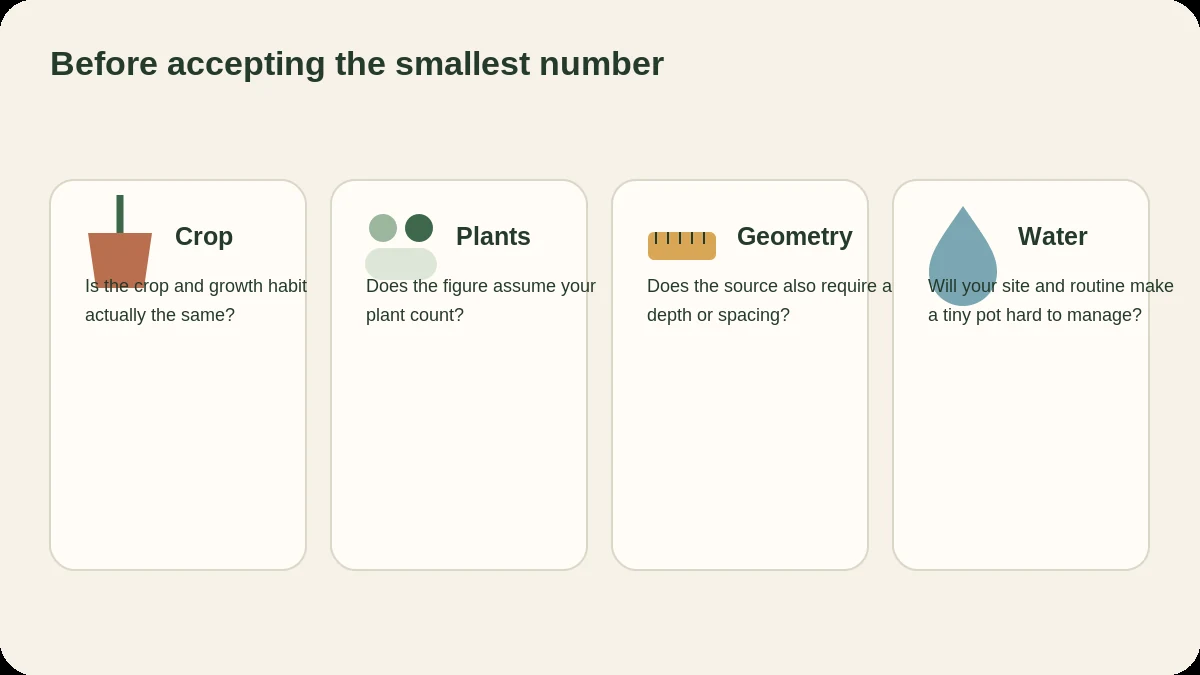
There is no single pot-size number that every reliable gardening source agrees on. For peppers, cucumbers and squash in particular, university Extension tables can differ by several gallons. The useful question is not “Which website has the one true number?” but “What did this source mean by minimum, for which plant type and planting density?”[S01][S03][S05][S06]
The table below reports published figures rather than converting them into a VETIKA “perfect pot” recommendation. That distinction is deliberate. A 5-gallon label, a 12-inch depth and a 16-inch diameter describe different properties, and two containers with the same nominal volume can behave differently in practice.[S02][S03]
1. Container-size chart: what reliable sources actually publish
The figures below come from Extension publications. They are shown side by side because the disagreement is itself useful information. “—” means the cited source does not provide an equivalent figure in the table used here; it does not mean the crop has no minimum.
| Crop | Maryland Extension (2026) | NC State | Other Extension example |
|---|---|---|---|
| Standard tomato | 5 gal (18.9 L) | 5 gal (18.9 L) | UGA: 5 gal determinate; 10 gal indeterminate |
| Cherry / patio tomato | 2 gal (7.6 L) | — | Illinois: 1 gal for cherry/patio types |
| Pepper | 5 gal (18.9 L) | 2 gal (7.6 L) | UGA: 2–3 gal; Illinois: ≥16 in diameter |
| Cucumber | 5 gal (18.9 L) | 1 gal (3.8 L) | Illinois: 1 gal / 2 plants; UGA groups cucumber with squash at 10 gal |
| Eggplant | 5 gal (18.9 L) | 5 gal (18.9 L) | UGA: 5 gal; Illinois: 2 gal |
| Summer squash / zucchini | 10 gal (37.9 L) | 2 gal (7.6 L) | UGA: 10 gal for cucumbers and squash |
| Bush beans | 2 gal (7.6 L) | 2 gal (7.6 L) | UGA: 2–3 gal; Illinois: 1 gal for 2–3 plants |
| Carrots | 2 gal (7.6 L) | 2 qt (1.9 L), 10 in depth | Illinois: 2 gal; cultivar root length is critical |
| Leaf lettuce | ½ gal (1.9 L) | 2 qt (1.9 L), 6–8 in depth | Illinois: 1 gal for 4–6 plants |
| Radish | 1 pint (0.47 L) | 2 qt (1.9 L), 4–6 in depth | Illinois: 2 gal; spacing and root type matter |
| Cabbage | 5 gal (18.9 L) | — | Illinois: 1 gal / 1 plant; Penn State: 5 gal example |
| Swiss chard | 2 gal (7.6 L) | 2 qt (1.9 L), 8 in depth | Illinois: 1 gal / 1 plant |
2. Why do reputable sources give different pot sizes?
First, “tomato,” “pepper” and “cucumber” are not single plant architectures. A dwarf patio tomato and a vigorous indeterminate tomato can have very different mature size and support needs. UGA, for example, separates determinate tomatoes at 5 gallons from indeterminate tomatoes at 10 gallons, while Maryland’s minimum table lists standard tomatoes at 5 gallons.[S01][S06]
Second, some publications express size as volume, others as diameter or depth. Illinois lists at least a 20-inch container for tomatoes and provides a separate diameter-to-soil-volume table. NC State adds minimum depth as well as volume for many crops. You cannot safely compare only one dimension.[S03][S05]
Third, the number of plants changes the interpretation. Illinois’s table places two cucumber plants in a one-gallon container, while Maryland’s 2026 overview lists five gallons for cucumbers. Those statements should not be blended into a simple average; they were produced in different guidance frameworks.[S01][S03]
Finally, a published minimum is not a guarantee of maximum yield, minimal watering or resilience during heat. Maryland notes that container size influences root restriction and water management, and that large indeterminate tomatoes can grow larger and produce more in bigger pots.[S01][S02]

3. Check usable volume, depth and surface area
A pot’s advertised diameter is not its soil volume. Tapered pots, thick walls, internal reservoirs and unfilled headspace all reduce the volume available to the growing mix. If the manufacturer publishes a litre or gallon capacity, check whether that refers to the whole vessel or the growing-medium compartment.
Depth matters for root crops and for anchoring larger plants. NC State, for example, pairs carrots with a 10-inch minimum depth and tomatoes with 12–24 inches. Maryland’s container-type guidance similarly advises considering both total volume and depth.[S02][S05]
Surface area matters for crops planted as rows or patches rather than one plant per pot. A wide trough can be more useful than a tall narrow pot for salad greens even when the two hold a similar volume.

4. Crop-by-crop notes for the 12 entries
The purpose of these notes is to help you interpret the chart, not to replace the variety label or local growing guidance.
| Crop | Interpretation note |
|---|---|
| Standard tomato | Growth habit matters. Do not infer plant size from fruit size. |
| Cherry / patio tomato | ‘Cherry’ describes fruit size; verify whether the variety is actually compact. |
| Pepper | Published minimums vary widely; use the named variety and local conditions to decide whether to size up. |
| Cucumber | Bush and vining cucumbers are not equivalent; support and water demand also change the decision. |
| Eggplant | For a tall, fruiting plant, stability and support are part of container selection. |
| Summer squash / zucchini | This is one of the clearest examples of source variation; check cultivar habit and the source context. |
| Bush beans | Plant count and spacing are part of the figure, not an afterthought. |
| Carrots | Depth can be more informative than total litres for root crops. |
| Leaf lettuce | Wide, shallow containers can be useful; decide whether you want baby leaves or mature plants. |
| Radish | A published container-volume minimum is not a universal pot prescription; geometry and spacing dominate here. |
| Cabbage | Cultivar size can differ substantially; compare the actual mature spread. |
| Swiss chard | Decide whether you will harvest young leaves or maintain full-size plants. |
5. When should you choose a larger container than the published minimum?
Consider sizing up when the plant is a vigorous or long-season variety, when the container must also provide stability for a tall supported crop, or when a very small reservoir of growing mix would make moisture management impractical for your routine. This is a decision framework, not a fixed “add X litres” rule.
Hot, reflective balconies can increase heat stress and water demand. Maryland specifically warns that brick, concrete and other hard surfaces can create hotter microclimates, and it notes that some containers may need daily watering in hot, dry conditions.[S01]
Porous materials can also dry more quickly than less porous ones. If two pots meet the same nominal volume, their water behaviour may still differ because of material, exposure, plant size and growing mix.

6. How to evaluate a pot you already own
Write down the internal dimensions, not just the decorative outside dimensions. If the pot is tapered, record top and bottom widths or diameters. If it includes a reservoir, separate reservoir capacity from growing-medium capacity.
Then record the crop, named variety if known, intended plant count and support method. Compare that complete setup with a relevant source. If the source specifies depth or spacing as well as volume, check all of those conditions.
When a container clearly falls below the guidance you are using, the safer planning response is to change either the container, the crop or the plant count before planting. Do not use extra fertiliser as a substitute for missing physical root volume.
7. Common mistakes when reading pot-size advice
- Treating ‘cherry tomato’ as automatically meaning a dwarf tomato plant.
- Comparing litres from one source with diameter from another as though they were the same measurement.
- Ignoring how many plants the source places in each container.
- Using outside decorative dimensions instead of usable internal growing volume.
- Forgetting that a self-watering reservoir occupies part of the vessel.
- Choosing a pot by root-ball fit at transplanting rather than mature growth.
- Assuming a published minimum is also the easiest size to manage in heat.
- Adding gravel at the bottom as a substitute for proper drainage holes.
Sources: [S01][S02][S03][S05][S07]
A useful size chart should make its assumptions visible. If a page gives precise numbers without saying whether they refer to one plant, a compact variety, final-season size or just transplanting, treat the precision cautiously.
8. Build your own container-size plan
Use the included two-page worksheet to compare your crop, variety, plant count and container measurements with the source you chose. The worksheet deliberately has separate fields for volume, depth and uncertainty so that an unknown does not silently become a guessed value.
Download the printable container-size planning sheetThe worksheet does not calculate a universal answer. Its job is to preserve your assumptions so you can review the plan later.
Frequently asked questions
Is a 5-gallon pot enough for a tomato?
Several Extension sources publish 5 gallons as a minimum for standard or determinate tomatoes, while others distinguish larger indeterminate plants or give much larger diameter-based guidance. Check growth habit, support and your watering conditions rather than treating 5 gallons as a universal optimum.
Can I grow peppers in a 2-gallon pot?
Some Extension tables list 2 gallons for peppers, while other university guidance lists 5 gallons or more. A smaller figure can be workable in some contexts but may be less forgiving. Verify the variety and source assumptions before deciding.
Why are cucumber recommendations so different?
Sources differ in variety, plant count and what they call a minimum. Published figures in the sources reviewed here range from 1 gallon to 10 gallons. That is exactly why the source context matters.
Should I choose pot diameter or litres?
Use both when possible. Volume tells you how much growing medium fits; depth and surface area help describe root run, stability and planting layout. A single dimension is incomplete.
Do grow bags use the same size rules as rigid pots?
The crop still needs adequate root-zone volume, but material changes water behaviour and shape changes geometry. Use the published crop guidance as a reference and account for the bag’s actual filled volume and your conditions.
Does a self-watering planter need the same litres?
Compare the growing-medium compartment, not just the planter’s total external capacity. The reservoir occupies space and changes water management.
Method and limits
Research reviewed on 17 September 2026. Crop figures are reported as published by the cited Extension sources. VETIKA does not collapse conflicting minima into a fabricated consensus figure. US gallon conversions use 1 US gal = 3.785 L and are rounded to one decimal place.
Technical sources
- University of Maryland Extension — Growing Vegetables in Containers. Updated March 23, 2026; current overview and minimum container-volume table.
- University of Maryland Extension — Types of Containers for Growing Vegetables. Container size principles; emphasizes volume and depth; broader 8-10 gallon category for large vegetables.
- University of Illinois Extension — How to Grow Fruits, Vegetables & Herbs in Containers. Diameter-based minimums and container-size-to-soil-volume reference table.
- Penn State Extension — Cultivando hortalizas y flores en contenedores. Spanish-language Extension guidance with example container volumes and plant counts.
- NC State Extension — Plants Grown in Containers – Extension Gardener Handbook. Detailed minimum volume, spacing and depth table for vegetables.
- University of Georgia Cooperative Extension — Container Gardening: Thinking Outside the Box!. Crop-specific container volume examples including determinate and indeterminate tomatoes.
- University of Maryland Extension — Planting Vegetables in Containers. Drainage, filling, spacing and support guidance.
Frequently asked questions
Can vegetables grow in a 5-gallon bucket?
Many compact vegetables can grow in a container around this size, and it is a common starting point for individual fruiting plants. The real result still depends on crop vigor, drainage, weather and how consistently the root zone is watered.
Is container depth or volume more important?
Both matter. Depth affects usable root profile, while total volume influences water reserve and the amount of growing medium available. Two pots with similar volume can behave differently if one is very shallow and the other is narrow and deep.
Is a bigger vegetable container always better?
Bigger containers are usually more forgiving, but they are heavier, need more growing mix and may be impractical on small balconies. The goal is adequate root volume and water reserve without creating a container that is unnecessarily difficult to move or support.