
The essentials
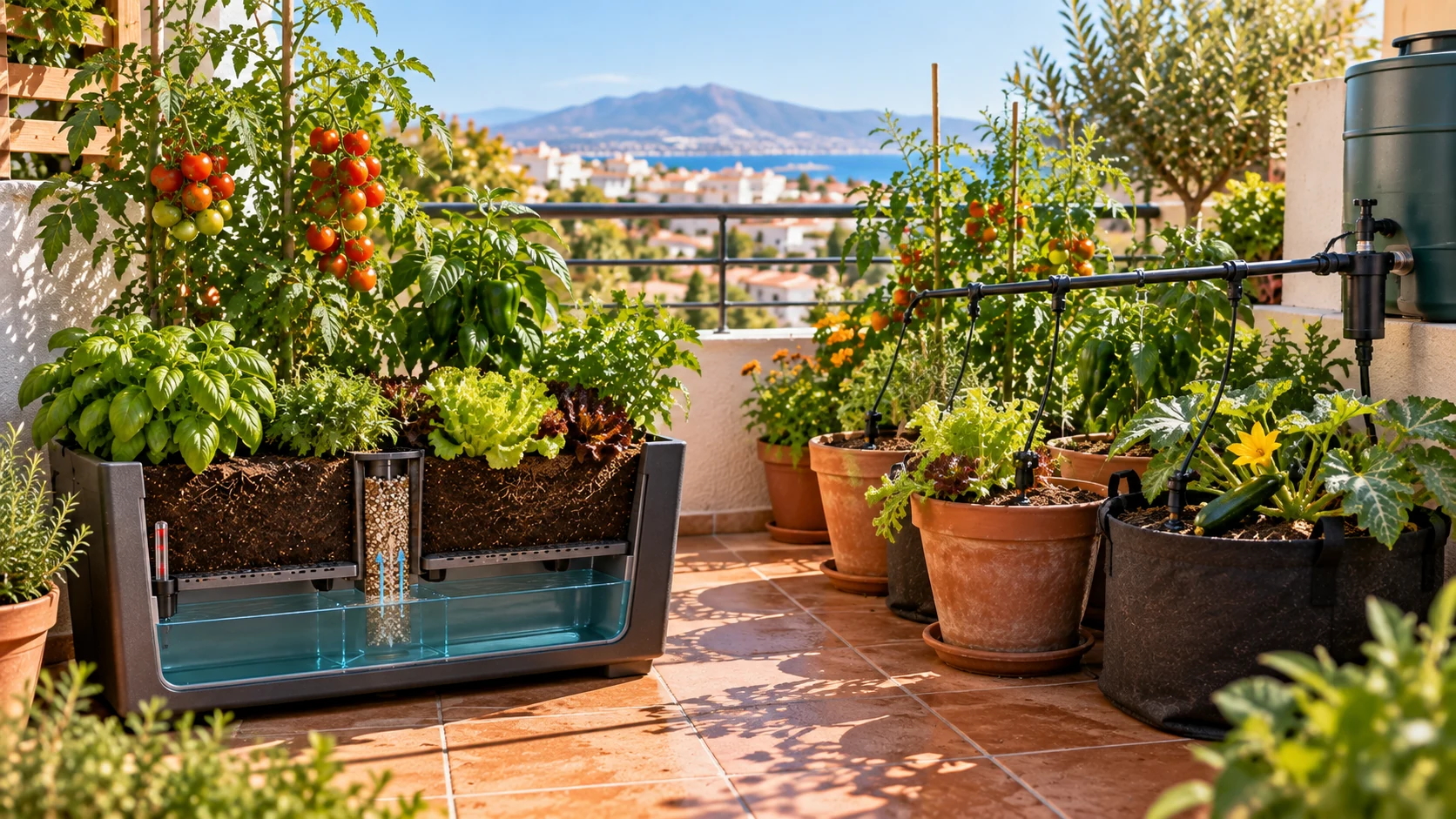
Two systems can substantially reduce the work of watering a container vegetable garden: storing water inside each planter using a self-watering reservoir or delivering water to conventional containers through a drip network.
Both can work very well, but they solve the problem differently.
A self-watering planter integrates a reservoir beneath the growing medium and uses capillary action —and, in some designs, direct root access to the reservoir— to make water available. A drip system keeps conventional containers and delivers water through tubing and emitters.
The useful question is therefore not “which is better?” but:
which system fits your number of containers, water access, maintenance routine, crops and automation needs?
Quick answer
Choose self-watering planters when:
- you have a small or moderate number of containers;
- you want each planter to hold its own reserve;
- you do not want a permanent tubing network;
- containers need some hydraulic independence;
- refilling individual reservoirs is acceptable.
Choose drip irrigation when:
- you have many containers;
- you want a shared water source;
- timed irrigation matters;
- you can install compatible tubing, filtration and pressure components;
- you expect the garden to expand.
Consider a hybrid system if you want local reservoirs but also want to automate reservoir refilling.
1. What a self-watering planter actually does
University of Maryland Extension describes self-watering containers with a perforated platform above a lower reservoir. Water can wick upward into the growing medium, while roots may reach the reservoir zone in some designs. [S1][S2]
Typical components include:
- container body;
- reservoir;
- separation platform;
- wick or soil column;
- fill tube;
- overflow.
The important point is that water storage is integrated into the container.
Each planter therefore behaves largely as its own hydraulic unit.
2. What drip irrigation actually does

Drip irrigation moves storage or water supply outside the individual container.
A typical setup may include:
- tap, reservoir or pump;
- mainline;
- branches;
- filter;
- regulator where required;
- emitters;
- timer when automated.
Water is delivered to defined points in the growing medium.
UC ANR evaluates drip performance using emitter discharge and operating-pressure measurements because uniformity can be influenced by pressure, friction, elevation and emitter condition. [S4][S5]
3. First difference: where the water is stored
Self-watering planter
The reserve sits inside or directly beneath each planter.
Advantages:
- each plant has a local reserve;
- a failure in another planter does not necessarily remove its water supply;
- no permanent tube has to cross the entire terrace.
Limitations:
- multiple reservoirs must be checked;
- 30 planters may mean 30 refill points;
- reserve volume is constrained by each planter design.
Drip irrigation
Water comes from a shared source.
Advantages:
- one reservoir or tap can serve many containers;
- delivery and scheduling are centralised;
- expansion can be relatively modular if capacity remains available.
Limitations:
- a source, pump, filter or mainline failure can affect many plants;
- total demand must be designed rather than assumed.
4. Number of containers matters
2-5 containers
Self-watering can be very simple because it avoids building a network for only a few points.
6-15 containers
Either system can make sense. Water access, layout and absence frequency become important.
20, 30 or more containers
Drip becomes increasingly attractive operationally because water delivery can be centralised.
These are planning ranges, not agronomic thresholds. There is no magic number at which one system automatically wins.
5. Which system requires less maintenance?

It depends on the type of maintenance.
Self-watering: distributed maintenance
You inspect:
- reservoir level;
- wick or capillary column;
- overflow;
- roots entering reservoir spaces;
- salts or sediment;
- growing-medium condition.
VETIKA A08 addresses the specific case where a reservoir contains water but the growing medium remains too dry.
Drip: network maintenance
You inspect:
- filter;
- operating pressure;
- tubing;
- fittings;
- emitters;
- clogging;
- discharge distribution.
Oklahoma State University identifies filtration as a critical drip-irrigation issue because the small emitter passages can be blocked by particles, precipitated minerals or biological growth. [S6]
Practical conclusion: self-watering distributes maintenance across containers; drip concentrates much of it in a shared network.
6. Which gives more autonomy?
You cannot answer without measuring.
Self-watering autonomy depends on:
usable reservoir water ÷ actual system water use
Reservoir-fed drip autonomy depends on:
usable source water ÷ programmed delivery to all emitters
VETIKA T01 calculates the second case using measured flow and scheduled irrigation events.
Illustrative example
Imagine:
- four self-watering planters;
- 8 L usable reserve in each.
Distributed reserve: 32 L.
Compare that with one drip reservoir containing 40 L of usable water.
You cannot conclude that drip will last longer just because 40 is greater than 32. You must also know programmed delivery and actual plant demand.
7. Uniformity means different things
Self-watering
Uniformity is primarily evaluated inside each planter:
- is the root zone uniformly moist?
- is wick contact reliable?
- are some zones too wet while others stay dry?
- is the growing medium suitable?
Drip
Uniformity must also be evaluated between emitters and between containers.
UC ANR explains that pressure differences, elevation and friction can change emitter discharge, and that actual discharge should be measured and compared. [S4][S5]
Twenty emitters carrying the same nominal label do not automatically create a uniform installed system.
8. Water access: tap, reservoir or none
No outdoor tap
Self-watering can be attractive because each reservoir can be filled manually.
Drip is still possible from a gravity tank or compatible pump system.
VETIKA A04 compares tapless balcony-watering options.
Easy access to a tap
Drip is easier to automate, although pressure and filtration still need to match the components.
Water arrives only in a watering can
Local reservoirs avoid tubing but require individual filling.
9. Electricity
A basic self-watering planter needs no electricity.
Drip does not automatically require electricity either. It may run from mains water pressure, gravity, mechanical devices or battery-powered timers.
Once pumps, sensors and advanced controllers are introduced, electrical dependency increases.
Do not choose based only on the word “automatic.” Identify the water source, pressure source and energy source.
10. Mobility and changing the layout
Self-watering planters are hydraulically independent, but a full reservoir adds substantial weight.
Large filled planters may be difficult to move.
Drip can serve lighter conventional containers, but those containers are physically connected to tubing and must be disconnected when the layout changes.
If the terrace is rearranged frequently, consider:
- quick connectors;
- modular tubing;
- appropriate wheeled bases;
- reservoirs that can be drained before moving.
11. What happens when something fails?
Self-watering failure
Often local to one container:
- displaced wick;
- stuck level gauge;
- blocked overflow;
- hydrophobic growing medium.
Drip failure
Can be local or systemic.
Local:
- blocked emitter;
- kinked microtube.
Systemic:
- empty source reservoir;
- pump failure;
- clogged filter;
- closed valve;
- timer failure.
A shared infrastructure makes single points of failure an important design consideration.
12. Scalability
Drip is often more modular for a growing collection of containers.
You can add:
- branches;
- zones;
- emitters;
- laterals.
But every expansion increases hydraulic demand.
Do not add containers indefinitely without checking source capacity, pressure, tubing diameter, total flow and uniformity.
Self-watering scales differently: you add complete independent units, but also add more reservoirs to inspect and refill.
13. Initial cost versus complete-system cost
Do not compare only:
price of a self-watering planter vs price of one emitter.
Compare complete setups.
Self-watering
Include:
- planter;
- reservoir;
- capillary mechanism;
- gauge where supplied;
- compatible growing medium.
Drip
Include:
- tubing;
- emitters;
- filter;
- regulator when needed;
- connectors;
- timer;
- pump or source reservoir where applicable.
With only a few containers, a sophisticated network can be disproportionate. With many containers, buying a complete self-watering planter for every plant can become expensive.
A10 intentionally avoids specific prices because they vary by country, season and product quality.
14. Water use
It is not responsible to claim automatically that one system “saves X percent.”
Actual water use depends on design and management.
Maryland notes that self-watering containers can conserve water and nutrients by keeping water in a local reservoir. [S1]
Drip can deliver low, controlled flows directly to the growing medium, but performance depends on uniformity, scheduling and leaks.
A fair comparison measures:
water added → water stored/applied → drainage/losses → plant response
15. Fertilisation
Salts may behave differently in a self-watering reservoir system than in a top-watered container with regular free drainage.
Drip frequency and volume also influence salt accumulation and leaching.
Therefore:
- follow crop guidance;
- respect planter/product instructions;
- do not automatically add fertiliser to a reservoir because water is stored there;
- watch for deposits and symptoms.
A future guide can cover nutrition in container gardens without overloading this system comparison.
16. Rain
Self-watering
A properly designed overflow limits maximum reservoir level, while rain also wets the growing medium from above. [S1][S3]
Drip
The programme may continue after rainfall unless it is adjusted or connected to additional controls.
In either system, a brief shower may wet only part of the growing medium.
17. Holidays and absences
Do not choose based on marketing phrases such as “up to two weeks.”
Self-watering
You need to know:
- usable reserve;
- approximate water use;
- expected conditions;
- plant size.
Drip
You need to verify:
- source;
- flow;
- programme;
- reservoir capacity when applicable;
- reliability of the complete system.
VETIKA A05 provides a pre-vacation testing procedure so that a short test is not mistaken for a guarantee.
18. Which fits common scenarios?
| Scenario | Practical tendency |
|---|---|
| 3 containers and no tap | Self-watering may be simpler |
| 12 aligned containers with nearby tap | Drip is very attractive |
| Balcony rearranged frequently | Independent planters or highly modular drip |
| 30 containers | Centralised drip often becomes easier to manage |
| One important plant you want isolated from shared-system failures | Local reservoir offers independence |
| Several groups with different schedules | Zoned drip offers flexibility |
| You dislike visible tubing | Self-watering |
| You dislike refilling individual reservoirs | Drip |
These are tendencies, not universal rules.
19. What about combining both?
A hybrid can be useful.
Example:
- reservoir planters;
- a water line periodically refilling each reservoir;
- overflow control in every unit.
This maintains local reserve while centralising part of the refill process.
However, hybrid systems combine components from both approaches. You must manage overfilling, unequal refill rates and valve or float failures.
Hybrid does not automatically mean simpler.
20. Build your own decision matrix
Rate the importance of each criterion from 1 (low) to 5 (high):
| Criterion | Importance | Self-watering | Drip |
|---|---:|---:|---:|
| Minimal visible tubing | ___ | ___ | ___ |
| Many containers | ___ | ___ | ___ |
| Easy expansion | ___ | ___ | ___ |
| Mobility | ___ | ___ | ___ |
| Centralised refill | ___ | ___ | ___ |
| Container independence | ___ | ___ | ___ |
| Timed scheduling | ___ | ___ | ___ |
| Maintenance that fits your routine | ___ | ___ | ___ |
VETIKA does not pre-fill a “winner” because criterion importance belongs to the user.
21. Five-question decision flow

1. How many containers will you manage?
Few → seriously consider self-watering.
Many → evaluate drip.
2. Is a central water source accessible?
Yes → drip becomes simpler.
No → self-watering or tank-fed drip.
3. Do you move containers frequently?
Yes → minimise permanent connections.
No → a fixed network can work well.
4. Which maintenance do you prefer?
Checking individual reservoirs → self-watering.
Maintaining one shared network → drip.
5. Do you need timed automation?
Yes → drip commonly offers more options.
Not necessarily → a passive reservoir may be enough.
22. Test before buying the complete system
Do not equip 30 containers on day one.
Self-watering pilot
Test:
- one representative planter;
- one representative crop;
- reservoir level;
- moisture at several depths;
- refill interval.
Drip pilot
Test:
- 3-5 containers;
- emitter flow;
- distribution;
- schedule;
- drainage and actual moisture.
Then scale.
A small pilot reduces the risk of buying an entire system based only on marketing specifications.
23. When switching systems makes sense
Self-watering to drip
Consider it when:
- container count increases substantially;
- individual refilling takes too long;
- zoning is needed;
- central automation becomes important.
Drip to self-watering
Consider it when:
- the garden becomes smaller;
- access to the tap is lost;
- the layout changes frequently;
- specific containers need independent reserves.
24. What to buy: functional checklist, not brand list
Self-watering
Check:
- growing-medium volume;
- real reservoir capacity;
- overflow;
- refill access;
- wick design;
- replaceable parts;
- reservoir-cleaning access.
Drip
Check:
- source and pressure;
- filter;
- tubing compatibility;
- emitter flow;
- timer;
- valves;
- spare parts;
- fittings.
Future affiliate recommendations on VETIKA should clearly disclose commercial links and should never replace these technical selection criteria.
25. Choosing for specific goals
I want the least visible infrastructure
Self-watering.
I expect to grow from 10 to 40 containers
Drip deserves priority evaluation.
I want each container to retain reserve even if another fails
Self-watering.
I want several groups controlled from one point
Zoned drip.
I want to leave for several days
Either can work after measurement and testing. Neither should be selected only because it is described as “automatic.”
FAQ
Do self-watering planters use less water?
They can conserve water and nutrients by storing water locally, but there is no universal savings percentage that applies across designs and climates. [S1]
Is drip better for many containers?
It is often easier to centralise and expand, but source flow, pressure and filtration still need to be designed.
Can drip refill self-watering planters?
Yes, hybrid systems can automate reservoir refilling, but they require level and overflow control.
Which works without electricity?
Either can work without electricity depending on water source and components.
Which requires less maintenance?
Self-watering distributes maintenance across containers; drip requires maintaining a shared network. Which feels simpler depends on container count and routine.
Which is better for tomatoes?
Tomatoes can grow with either approach when container size, water and nutrition are appropriate. Irrigation method does not replace adequate root-zone volume.
Conclusion
Self-watering and drip irrigation are not two versions of the same system.
Self-watering stores water next to each plant and reduces shared infrastructure. Drip centralises delivery and usually scales more easily as the number of irrigation points increases.
Base the decision on:
container count → water access → mobility → maintenance → automation → expansion.
If you still cannot decide, build a small pilot of each. One week of real observations on flow, moisture and maintenance effort is more valuable than a specification table without context.
Technical sources
- University of Maryland Extension: Self-Watering Containers
- University of Maryland Extension: Growing Vegetables in Containers and Salad Tables
- Mississippi State University Extension: Subirrigated Containers for the Mississippi Gardener
- University of California Agriculture and Natural Resources: Emitter Evaluations
- University of California Agriculture and Natural Resources: Surface Drip Tubing Distribution Uniformity Measures
- Oklahoma State University Extension: Drip Irrigation Systems